
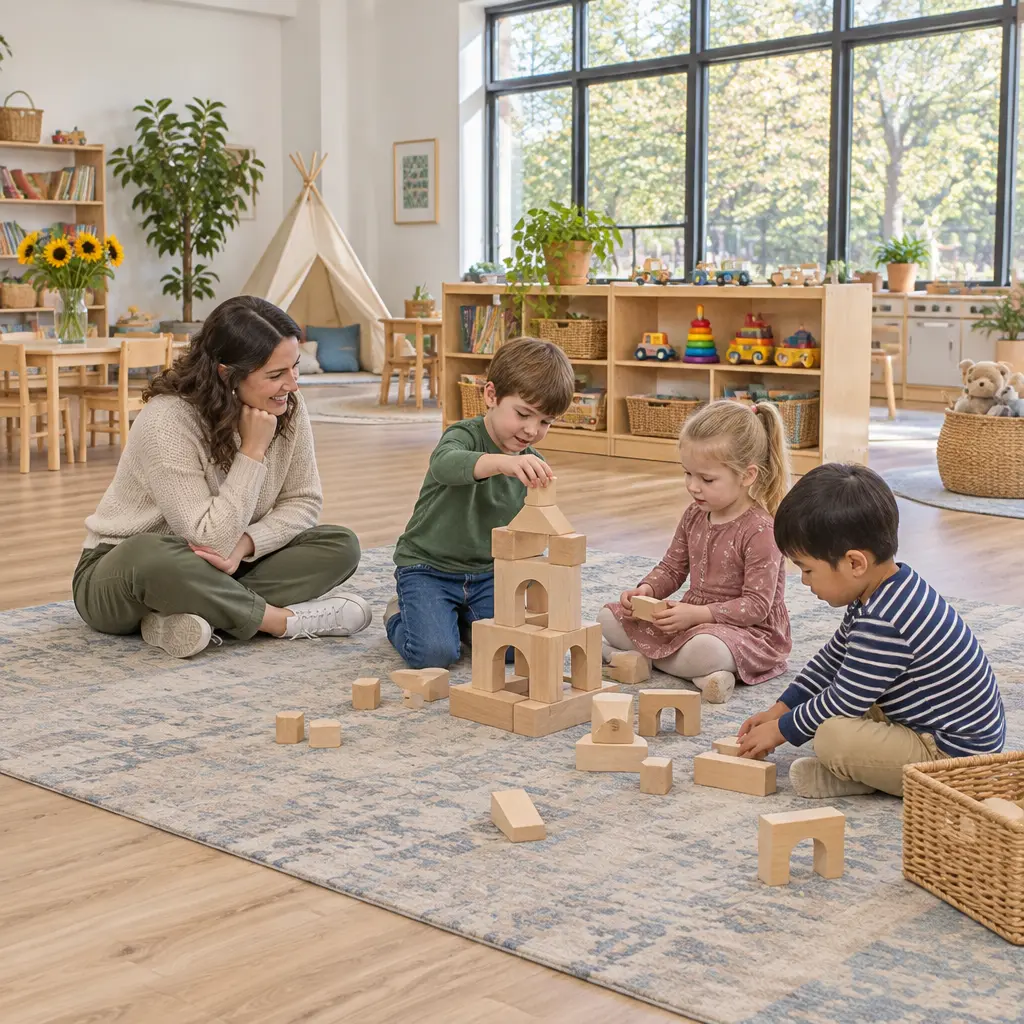
Child-initiated play is play that children choose and direct, often exploring ideas, materials, and social roles without adults prescribing a single outcome. Research suggests it can support learning when children have time, engaging materials, and responsive adults—not because every lesson must be unstructured, but because children learn through a range of experiences. A 2022 systematic review and meta-analysis found that guided play produced advantages over direct instruction in some outcomes, including early mathematics and shape knowledge, while results varied by skill and comparison group. This article explains what child-initiated play means, how it relates to guided play and executive function, what research can and cannot establish, and how families and educators can put the evidence into practice.
Child-Initiated Play and Its Learning Characteristics
Child-initiated play describes activity in which children have meaningful choice over what to do and how to do it. The National Association for the Education of Young Children (NAEYC) distinguishes free play, in which children lead, from guided play, in which an adult supports a learning goal while preserving children’s agency. In practice, the categories can overlap: a child may invent a pretend shop independently, then an adult may join by asking how the children will represent prices.
The key attributes are agency, active engagement, exploration, and room to adapt or change direction. Play may be solitary, social, physical, constructive, imaginative, or rule-based. These are related forms rather than a hierarchy: building a tower, negotiating roles in a pretend game, and making up rules for a ball game can all involve child-led decisions and learning opportunities.
Free play and child agency
Free play is activity that children initiate and direct, with adults providing a safe environment rather than setting a required product. Agency matters because children make choices, test their own ideas, and decide whether to persist, revise, or stop. The American Academy of Pediatrics (AAP) describes play as intrinsically motivated and often pleasurable, and notes that play can help children develop relationships, language, and problem-solving skills.
A child who turns cardboard boxes into a bus, for example, may assign roles, solve a practical problem about where passengers sit, and revise the design when it collapses. Those outcomes are plausible learning opportunities, not guaranteed results from every play episode. The adult’s role is to make time and materials available, protect safety, and avoid taking over the child’s plan.
Guided play as a related approach
Guided play combines child choice with purposeful adult support. Adults may arrange materials around a learning objective, model a strategy, or ask open-ended questions while leaving children in control of important decisions. It differs both from fully child-directed free play and from direct instruction, where the adult typically leads the activity and specifies what children should learn or do.
A 2022 review in Child Development synthesized 39 studies involving more than 17,000 children. It reported that guided play outperformed direct instruction on some measured outcomes, including early mathematics and shape knowledge, but not on every outcome; effects depended on the skill and comparison condition. This finding supports guided play as one useful teaching approach, not a claim that all child-initiated play is more effective than instruction.
Child-Initiated Play and Cognitive Development
Cognitive development includes learning to reason, remember, use language, and solve problems. Child-initiated play can create occasions to practise these processes because children encounter challenges that matter to them and can try different responses. Research supports links between play experiences and learning, but the strength of evidence differs by play type, outcome, age, and study design. Correlation alone does not prove that play caused a particular developmental gain.
Problem-solving, planning, and flexible thinking
Problem-solving in play involves noticing a challenge, generating possible solutions, and testing them. When children build a bridge for toy cars or devise rules for a game, they may plan, monitor what happens, and change their approach. These activities can support flexible thinking, but an adult should not assume that a child is practising a particular skill simply because an activity appears educational.
A useful response is to observe first, then offer a question that extends thinking without supplying the answer: “What could make the bridge steadier?” This kind of support keeps the child’s idea central while making the problem easier to notice and discuss.
Language, storytelling, and early literacy
Pretend play and collaborative games can prompt children to explain ideas, negotiate roles, tell stories, and learn words in context. For example, a pretend clinic may lead children to name tools, describe symptoms, and sequence events. Such play gives adults opportunities to respond to children’s language and introduce relevant vocabulary without turning every exchange into a quiz.
The AAP’s clinical report on the power of play describes play as a setting for language development and supportive adult-child interaction. It does not mean pretend play replaces shared reading, explicit vocabulary teaching, or other effective literacy practices; rather, play can complement them by giving words a meaningful social purpose.
Early mathematics and spatial learning
Children encounter mathematical ideas when they sort objects, compare quantities, build shapes, follow patterns, or distribute pretend food. Spatial play—such as fitting blocks together or rotating puzzle pieces—can help children notice shape, position, and relationships between parts. Adults can make these concepts more visible by naming them and asking questions while preserving children’s control of the activity.
The guided-play meta-analysis found benefits over direct instruction for certain early mathematics outcomes, including shape knowledge. Because the review examined varied interventions, it should not be read as a universal effect size for all free play or all children. The practical implication is to use play thoughtfully alongside direct teaching and other forms of practice.
Child-Initiated Play and Social-Emotional Development
Social-emotional development includes recognising feelings, communicating needs, forming relationships, and managing conflict. Child-initiated play gives children chances to practise these capacities in situations they help shape. Its value is especially evident in shared play, although solitary play can also offer pleasure, concentration, and self-directed exploration.
Cooperation, negotiation, and perspective-taking
In group play, children may decide who takes which role, agree on rules, and respond when a peer has a different idea. These exchanges can involve cooperation and perspective-taking. For instance, children building a pretend restaurant must coordinate what it serves and how customers place orders; disagreements may require them to explain, compromise, or change the game.
Adults can support inclusion without scripting the whole interaction. They might help a child find an entry point—“Could you ask whether the restaurant needs a cook?”—or intervene directly if play becomes unsafe or exclusionary. This balances children’s ownership with the adult responsibility to protect each child’s dignity and access.
Emotion regulation and resilience
Emotion regulation is the ability to notice and manage feelings in ways that support a situation. Play can involve excitement, disappointment, uncertainty, and frustration—for example, when a structure falls down or a game does not go as planned. With a calm, responsive adult nearby, children can practise expressing feelings and recovering from setbacks.
The AAP identifies play as a potential setting for children to develop coping skills and strengthen relationships with caregivers. These benefits depend on context: play should not be used to dismiss distress, and children who need adult help should receive it. Supportive participation means acknowledging feelings while allowing children to attempt manageable challenges.
Child-Initiated Play and Physical Health
Active play—running, climbing, dancing, and other movement chosen or shaped by children—contributes to physical activity and motor practice. It can also support exploration and confidence when environments are appropriately safe. This is one reason play matters beyond classroom achievement: children need opportunities to move, rest, interact, and experience their surroundings.
Movement, motor skills, and outdoor play
Outdoor play can invite children to practise balance, coordination, strength, and spatial judgement through activities such as navigating a path, kicking a ball, or carrying loose materials. The Centers for Disease Control and Prevention recommends that children ages 3 through 5 be physically active throughout the day, while children and adolescents ages 6 through 17 should get at least 60 minutes of physical activity daily. Active play can contribute to those opportunities, though it is not the only way to meet them.
A useful setting offers varied, accessible options rather than a single prescribed activity: open space, movable materials, places to climb or balance where appropriate, and quiet areas for children who need a pause. Adults should assess risks, supervise according to age and context, and make reasonable adaptations for children with disabilities.
Child-Initiated Play in Homes and Early Learning Settings
Putting evidence into practice does not require expensive toys or a choice between play and teaching. It requires predictable time, accessible materials, responsive adults, and attention to each child’s interests and needs. A mix of child-led play, guided play, explicit instruction, reading, rest, and physical activity can serve different learning goals.
Practical ways adults can support play
Caregivers and educators can protect children’s agency while enriching play through a few consistent practices:
- Offer open-ended materials, such as blocks, paper, fabric, recycled boxes, and safe natural objects.
- Allow sustained time so children can develop an idea rather than repeatedly stopping and restarting.
- Observe before joining; follow the child’s lead and ask open questions instead of directing every step.
- Use simple language to name concepts children are already exploring, such as “taller,” “under,” “more,” or “what happens next?”
- Provide inclusive materials and adapt spaces so children with differing abilities can participate.
- Step in promptly when safety, distress, or exclusion requires adult help.
A practical example is a block-building area. An adult can make blocks available, watch how children use them, and join briefly to ask whether a tower needs a wider base. If children have a specific curriculum goal, the adult can introduce relevant vocabulary or a challenge, then step back so children decide how to respond.
Balancing play with instruction and digital media
Play is not a substitute for every form of teaching. Children benefit from a balanced environment in which adults provide direct explanation when appropriate and also leave room for exploration, conversation, and practice. The right approach depends on the learning objective: a safety rule may need clear instruction, while exploring how materials balance may benefit from experimentation.
Digital experiences should also be judged by what children do, not simply by whether a screen is present. The AAP recommends prioritising healthy routines, high-quality content, and adult engagement where appropriate. Hands-on play, sleep, movement, and face-to-face relationships should not be displaced by excessive or poorly chosen screen use.
What the Evidence on Child-Initiated Play Can and Cannot Show
Research supports play as an important context for development, but “play” covers many different activities and study methods. A result from a structured guided-play intervention cannot automatically be applied to all free play, all ages, or every academic and social outcome. Studies also differ in how they define play, measure learning, and compare activities.
The 2022 systematic review of guided play is useful because it compares outcomes across dozens of studies, yet its findings remain outcome-specific. The AAP’s policy report and NAEYC’s developmentally appropriate practice guidance offer professional recommendations that draw on broader evidence and practice, rather than serving as single experimental tests. Together, these sources support a measured conclusion: play is a valuable part of children’s learning environments, and its benefits are strongest when claims match the evidence and adults respond to children’s developmental needs.
Conclusion: Make Room for Child-Initiated Play
Child-initiated play gives children agency to explore, communicate, solve problems, and practise social and physical skills. Research on guided play finds advantages for some learning outcomes, while evidence does not establish that every form of play outperforms instruction in every domain. The most defensible approach is a balanced one: provide safe, inclusive materials and ample time, follow children’s ideas, offer thoughtful support, and use direct teaching when it fits the goal. Families and educators can begin by protecting a regular period for child-led play and observing what children learn, ask, and attempt.
Sources: Skene et al., “Can Guidance During Play Enhance Children’s Learning and Development in Educational Contexts? A Systematic Review and Meta-Analysis,” Child Development, 2022, https://srcd.onlinelibrary.wiley.com/doi/10.1111/cdev.13730; Yogman et al., “The Power of Play: A Pediatric Role in Enhancing Development in Young Children,” Pediatrics, 2018, https://publications.aap.org/pediatrics/article/142/3/e20182058/38649/The-Power-of-Play-A-Pediatric-Role-in-Enhancing; National Association for the Education of Young Children, “Principles of Child Development and Learning and Implications That Inform Practice,” https://www.naeyc.org/resources/position-statements/dap/principles; Centers for Disease Control and Prevention, “Physical Activity Guidelines for School-Aged Children and Adolescents,” https://www.cdc.gov/physical-activity-basics/guidelines/children.html; American Academy of Pediatrics, “Media and Young Minds,” https://publications.aap.org/pediatrics/article/138/5/e20162591/60503/Media-and-Young-Minds.