
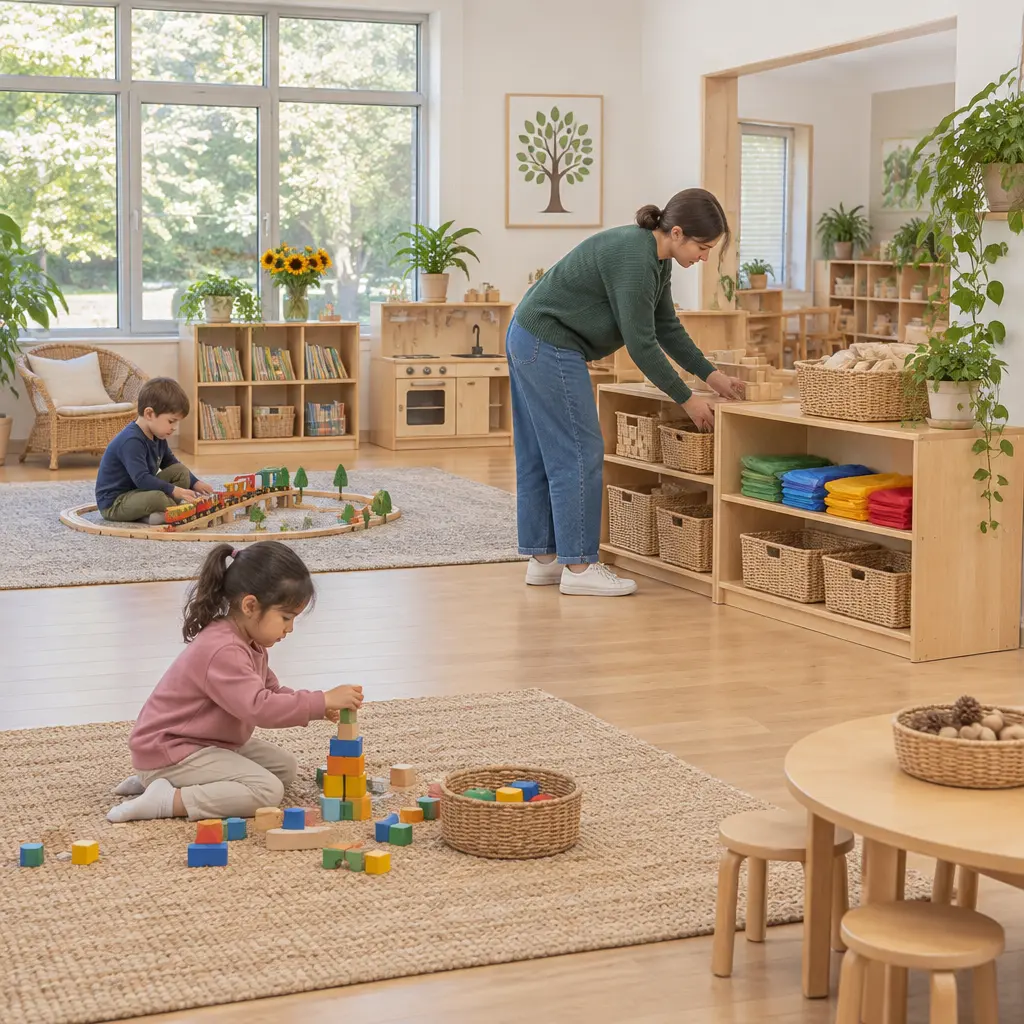
Setting up environments that invite child-led play means arranging spaces, materials, and routines so children can choose what to explore, start activities, and develop their ideas—with adults providing safety, access, and responsive support. These environments matter because play is a central way young children learn: the American Academy of Pediatrics describes play as supporting healthy brain development, while a 2018 review of 26 studies involving more than 10,000 children found that play-based learning can support early academic outcomes. Thoughtful design combines accessible materials, flexible indoor and outdoor areas, predictable routines, and adults who observe before stepping in.
Child-Led Play Environments: Definition and Core Characteristics
A child-led play environment is a space in which children have meaningful opportunities to initiate, choose, and shape play, rather than simply follow adult-directed instructions. The National Association for the Education of Young Children (NAEYC) describes play as engaging, meaningful, socially interactive, iterative, and joyful; its guidance emphasizes balancing children’s agency with intentional teaching. In practice, this approach is not the absence of adult involvement. Educators arrange the environment, make materials available, protect time for play, and respond when support is useful.
Common forms include free play, pretend or dramatic play, constructive play with loose parts, sensory and exploratory play, and outdoor or nature play. These forms often overlap: a child might gather sticks outdoors, build a shelter, and then turn it into a pretend home. The key measure is not whether an activity looks busy or educational to an adult, but whether children can make decisions, test ideas, and continue or change their play.
Child Choice and Agency
Agency means children can make consequential choices, such as selecting materials, deciding how to use them, choosing a play partner, or returning to an unfinished project. Choice is more than offering two adult-selected tasks: children need room to set their own direction. The Center on the Developing Child at Harvard University explains that responsive interactions help build the foundations of brain architecture; when adults notice children’s interests and respond appropriately, they can support engagement without taking over the activity.
Open-Ended Materials and Loose Parts
Open-ended materials can be used in many ways and do not prescribe a single finished product. Blocks, fabric, cardboard, natural objects, containers, and washable art supplies can support planning, problem-solving, storytelling, and collaboration. NAEYC’s guidance on developmentally appropriate practice recommends materials that reflect children’s abilities, interests, and cultural contexts. A small, well-organized selection that children can reach independently may invite deeper exploration than a crowded shelf of toys that are difficult to access.
Adult Support Without Taking Over
The adult role is to prepare, observe, and respond with care. An educator might describe what a child is doing, offer a relevant word, or ask an open question such as “What could make the bridge stronger?” rather than supplying the solution. The American Academy of Pediatrics’ clinical report on the power of play recommends that adults allow children to lead while remaining available and engaged. Adult support should also include clear safety limits and help with sharing or conflict when children need it.
Space and Materials That Support Independent Exploration
Once children have genuine choice, the physical arrangement determines whether they can act on it. A supportive space is welcoming, easy to navigate, and organized so children can see what is available and return materials when finished. The National Association for the Education of Young Children recommends accessible, thoughtfully arranged learning areas, with clear pathways and materials suited to children’s developmental stages. These principles apply in classrooms, childcare settings, and homes, even when space is limited.
Accessible, Clearly Defined Play Areas
Defined areas help children recognize possibilities: a quiet nook can invite reading or rest, while a construction area can hold blocks and building pieces. Low shelves, picture labels, and containers children can open encourage independent selection and clean-up. Keep routes clear for children using mobility aids, and position frequently used materials within reach. When a room serves several purposes, movable baskets, mats, or screens can create flexible play zones without requiring permanent fixtures.
A Balanced Selection of Materials
A balanced environment includes materials for making, pretending, building, moving, exploring, and relaxing. Rotate some items in response to children’s interests, but keep familiar favorites available so children can revisit and extend ideas. Choose materials that are durable, age-appropriate, and culturally inclusive; inspect them regularly for damage and choking or other hazards. The U.S. Consumer Product Safety Commission’s toy-safety guidance can help caregivers assess age labeling and common risks, but supervision and setting-specific safety checks remain essential.
Inclusive and Culturally Responsive Design
An inviting environment represents the children who use it and makes participation possible for different abilities, languages, and sensory needs. Include books, pretend-play props, images, and everyday objects that reflect varied families and communities without reducing cultures to stereotypes. Offer alternatives such as large-handled tools, visual cues, quiet spaces, and materials with different textures. NAEYC’s developmentally appropriate practice framework emphasizes responding to each child’s strengths, needs, and context; observing who can access an area—and who cannot—helps turn that principle into practical adjustments.
Routines, Relationships, and Outdoor Play
A well-designed room cannot support sustained child-led play if the day is constantly interrupted or children do not feel secure. Predictable routines, warm relationships, and time to return to ideas help make the environment usable. Outdoor areas extend the same opportunities through movement, changing weather, natural materials, and larger-scale construction. The World Health Organization’s 2019 guidelines recommend that children aged 3–4 accumulate at least 180 minutes of physical activity across the day, including at least 60 minutes of moderate-to-vigorous activity; active outdoor play can contribute, while also serving purposes beyond exercise.
Protected Time and Predictable Transitions
Sustained play gives children time to develop an idea, encounter a problem, and try another approach. Frequent transitions can break that sequence, so educators and caregivers can protect a substantial play period and give advance warnings before changes. Predictable routines—such as choosing a play area, using materials, and tidying together—help children anticipate what comes next without making every moment adult-directed. If a project cannot remain in place, a labeled tray or photograph can help children resume it later.
Outdoor and Nature-Based Play
Outdoor play offers room for running, balancing, digging, observing, and building with natural or reusable materials. A nature-rich space does not need elaborate equipment: logs, sand, water, plants, and loose parts can prompt varied play when they are provided safely and accessibly. The American Academy of Pediatrics notes that play supports physical, social-emotional, and cognitive development. Outdoor design should account for weather, shade, hydration, supervision, accessible routes, and local hazards, with risk managed rather than eliminated so children can attempt appropriate challenges.
Responsive Relationships and Co-Regulation
Children are more likely to explore when trusted adults are emotionally available. Co-regulation means an adult helps a child manage strong feelings through calm presence, clear language, and support suited to the moment. Adults can observe first, join play when invited, and step in when safety, exclusion, or persistent conflict requires help. This approach preserves children’s ownership while ensuring that independent play does not become unsupported play.
Putting Child-Led Play Design into Practice
A useful starting point is to watch how children use the existing environment, then make small changes and observe what happens. The following sequence can help families and educators connect design decisions with children’s actual play rather than relying on assumptions.
- Observe which areas children choose, where they linger, and where access or conflicts become difficult.
- Make a few versatile materials visible and reachable, with enough space for children to use them safely.
- Protect uninterrupted play time and use predictable transition cues.
- Join play responsively: notice, listen, and offer help without directing the storyline or expected outcome.
- Review participation regularly, including whether children with different abilities and communication styles can take part.
For example, if children repeatedly turn cushions into a den, an educator might add fabric clips, lightweight fabric, and a clear storage basket, then watch how the play develops. The adult can establish safe limits for climbing or blocking exits while leaving the design and pretend scenario to the children. This small adjustment links children’s observed interests with accessible materials and appropriate supervision.
Conclusion: Environments That Make Child-Led Play Possible
Child-led play depends on more than toys: it grows from meaningful choice, open-ended materials, accessible and inclusive spaces, protected time, supportive relationships, and safe opportunities indoors and outdoors. Research and guidance from NAEYC, the American Academy of Pediatrics, Harvard’s Center on the Developing Child, and the World Health Organization reinforce the importance of play and responsive environments for children’s development and well-being. Start by observing children, making one practical change, and checking whether it expands their ability to choose, explore, and return to ideas. For further guidance, consult developmentally appropriate practice resources and current local safety recommendations.
Sources: National Association for the Education of Young Children, Developmentally Appropriate Practice Position Statement, https://www.naeyc.org/resources/position-statements/dap; National Association for the Education of Young Children, The Power of Playful Learning in the Early Childhood Setting, https://www.naeyc.org/resources/pubs/yc/summer2022/power-playful-learning; American Academy of Pediatrics, The Power of Play: A Pediatric Role in Enhancing Development in Young Children, https://publications.aap.org/pediatrics/article/142/3/e20182058/38649/The-Power-of-Play-A-Pediatric-Role-in-Enhancing; Yogman et al., The Power of Play: A Pediatric Role in Enhancing Development in Young Children, Pediatrics, 2018, https://doi.org/10.1542/peds.2018-2058; Center on the Developing Child at Harvard University, Serve and Return, https://developingchild.harvard.edu/science/key-concepts/serve-and-return/; World Health Organization, Guidelines on Physical Activity, Sedentary Behaviour and Sleep for Children Under 5 Years of Age, 2019, https://www.who.int/publications/i/item/9789241550536; U.S. Consumer Product Safety Commission, Toy Safety, https://www.cpsc.gov/Safety-Education/Safety-Guides/Toys