
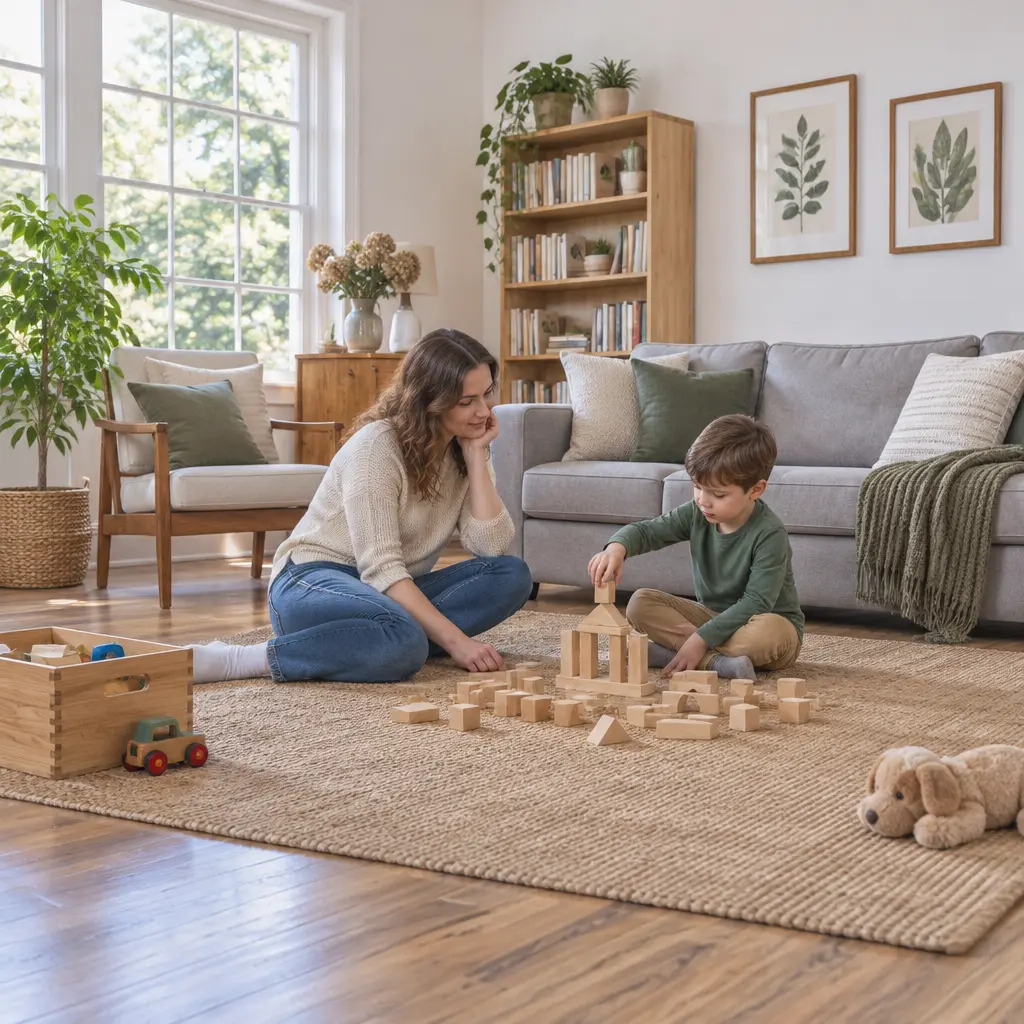
Child-led play is play in which children choose the activity, direct what happens, and explore at their own pace while adults provide a safe, responsive environment. At home, it doesn’t require a special playroom or a long block of free time: a few minutes of following your child’s idea, everyday household materials, and predictable opportunities to play can make a difference. The American Academy of Pediatrics (AAP) describes play as important to children’s development and relationships, while a 2018 AAP clinical report noted that children in the United States had lost an estimated 8 hours of free play per week over two decades. Simple routines, open-ended materials, and supportive adult behavior can help families make room for play even on busy days.
Child-led play means giving children agency at home
Child-led play is an approach in which the child takes the lead in choosing and shaping play, and the adult follows the child’s interests rather than setting a required outcome. The AAP’s clinical report, “The Power of Play,” links play with children’s cognitive, physical, social, and emotional development. It also describes play as a way for children to practice relationships, language, self-regulation, and problem-solving.
Child-led does not mean leaving a child unsupervised or refusing to set limits. Adults still protect safety, offer connection, and help when needed. The key distinction is who controls the play’s purpose: a child might turn a cushion into a boat, while the adult joins as a passenger rather than instructing them to build a particular craft.
Related forms include independent play, in which a child plays alone; shared play, in which an adult or sibling joins on the child’s terms; and guided play, in which an adult creates a learning opportunity while preserving the child’s choices. These approaches can overlap. For example, a parent might set out blocks and then let a child decide whether to build a tower, a road, or something entirely different.
Child-led play supports learning through choice
In child-led play, children make decisions, test ideas, and adjust their plans. A tower that falls invites another attempt; pretend shop play creates opportunities to negotiate roles and use language. The AAP notes that play can support executive-function skills, including attention, working memory, and self-regulation. These are developmental benefits, not a reason to turn every play session into a lesson: the child’s own exploration remains central.
Play can be brief and still fit family life
There is no single minimum number of minutes that makes play child-led or beneficial. A short, attentive stretch can be a practical starting point, particularly when a caregiver has limited time. The AAP’s 2018 report cited an estimate that children had lost 8 hours of free play weekly over the previous 20 years, underscoring why everyday opportunities matter. Treat that figure as a historical estimate from the report, not a current measurement of every child’s schedule.
Simple routines make child-led play easier on busy days
A routine is a repeatable cue that helps play happen without requiring elaborate planning. Rather than waiting for a completely free afternoon, families can attach a small play opportunity to moments they already have, such as after snack or while dinner is being prepared. The routine should be flexible: if the child is tired, a quiet activity or no activity may be the right choice.
Try a short, phone-free play window
Set aside a few minutes when you can give your attention without multitasking. Invite your child to choose what to do, then watch and follow their lead. Describe what you notice—“You’re making a long bridge”—or join the pretend scenario if invited. Avoid quizzing, correcting, or taking over the activity. If you need to stop, give a clear, kind warning and help your child transition.
Use transitions and household tasks as play openings
Everyday routines can provide natural invitations. While waiting for food, a child might arrange safe containers; during tidying, toys can “travel” to their homes; on a walk to the mailbox, a child can lead a pretend expedition. These are options, not extra tasks to complete. Keep the activity child-directed and avoid turning chores or transitions into a performance the child must get right.
Make independent play gradual and age-aware
Independent play means a child occupies themselves without an adult actively directing the activity; it does not mean being left without appropriate supervision. Some children need an adult nearby before they feel ready to play alone. Start by staying close, then gradually shift your attention when the child is settled. Choose a safe space and materials suited to the child’s age, abilities, and mouthing habits.
Open-ended materials invite children to direct play
Open-ended materials are objects that can be used in many ways rather than having one required function or result. Blocks, paper, washable crayons, fabric, and pretend-play items can support changing ideas. The National Association for the Education of Young Children (NAEYC) emphasizes the value of play-based learning and environments that let children explore, make choices, and use materials in flexible ways. A large collection is not necessary; a few accessible, safe options can be enough.
Choose simple materials with more than one use
Offer a small selection such as blocks, cardboard boxes, drawing supplies, play figures, or clean containers. A box might become a cave, bus, or shop; the child decides. Rotate a few items when interest fades instead of adding more toys. Keep small parts, cords, plastic bags, breakable objects, and other hazards away from young children, and supervise materials according to age and ability.
Let the child’s idea shape the adult’s role
A responsive adult notices the child’s signals and joins without commandeering the play. If a child says the blocks are a hospital, follow that story instead of insisting they build a house. You can add language, offer a prop, or wonder aloud—“I wonder where the ambulance goes”—then leave room for the child to respond or ignore the suggestion. If the child prefers to play alone, respectful observation can be support too.
Use gentle boundaries without taking over
Boundaries keep play safe and workable while preserving as much child choice as possible. State the limit simply, then offer an acceptable alternative: “The blocks stay on the floor; you can build your tower here.” When feelings or disagreements arise, help children name what is happening and consider options without deciding every detail for them. Safety rules are firm; the story, construction, or pretend roles can remain theirs.
A realistic child-led play plan adapts to different family days
The best plan is one a family can sustain. Child-led play can happen alone, alongside an adult’s routine, or with siblings, and it can change as children grow. Rather than measuring success by a finished project or a precise daily quota, notice whether the child has opportunities to choose, explore, and return to play.
On a very busy day, offer one small choice
Put two or three safe options within reach and ask what the child would like to do. If you have only a few minutes, be present for that brief window, then explain what happens next. A small, genuine opportunity to lead is more consistent with child-led play than a long activity in which the adult controls every step.
When siblings play together, protect room for different ideas
Shared play can build cooperation, but children may want different roles or have different abilities. Offer duplicates of popular materials where practical, help children take turns choosing the game, and step in when safety or fairness requires it. Avoid making an older child responsible for entertaining a younger sibling; adult support may be needed to keep the play enjoyable for both.
When screens are part of family life, balance them with active play
Digital media can be part of family routines, but it should not crowd out sleep, movement, relationships, or opportunities for imaginative play. The AAP recommends family media planning that considers each child’s age and needs. A practical transition is to turn off a program and invite the child to continue its theme with drawing, toys, or pretend play, without requiring them to do so.
Conclusion: protect small opportunities for child-led play
Child-led play gives children agency to explore, imagine, and practice developing skills. Busy families can support it through short attentive moments, predictable routines, open-ended materials, and adult responses that follow rather than direct the child’s idea. Keep safety boundaries clear, adapt expectations to the child and the day, and remember that play does not need to produce a polished result. Choose one small opportunity to make space for your child to lead today, and consult guidance from the AAP and NAEYC for further ideas on play and development.
Sources: American Academy of Pediatrics, “The Power of Play: A Pediatric Role in Enhancing Development in Young Children,” Pediatrics, 2018, https://publications.aap.org/pediatrics/article/142/3/e20182058/38649/The-Power-of-Play-A-Pediatric-Role-in-Enhancing; American Academy of Pediatrics, HealthyChildren.org, “Media and Children,” https://www.healthychildren.org/English/family-life/Media/Pages/default.aspx; National Association for the Education of Young Children, “Principles of Child Development and Learning and Implications That Inform Practice,” https://www.naeyc.org/resources/position-statements/dap/principles