
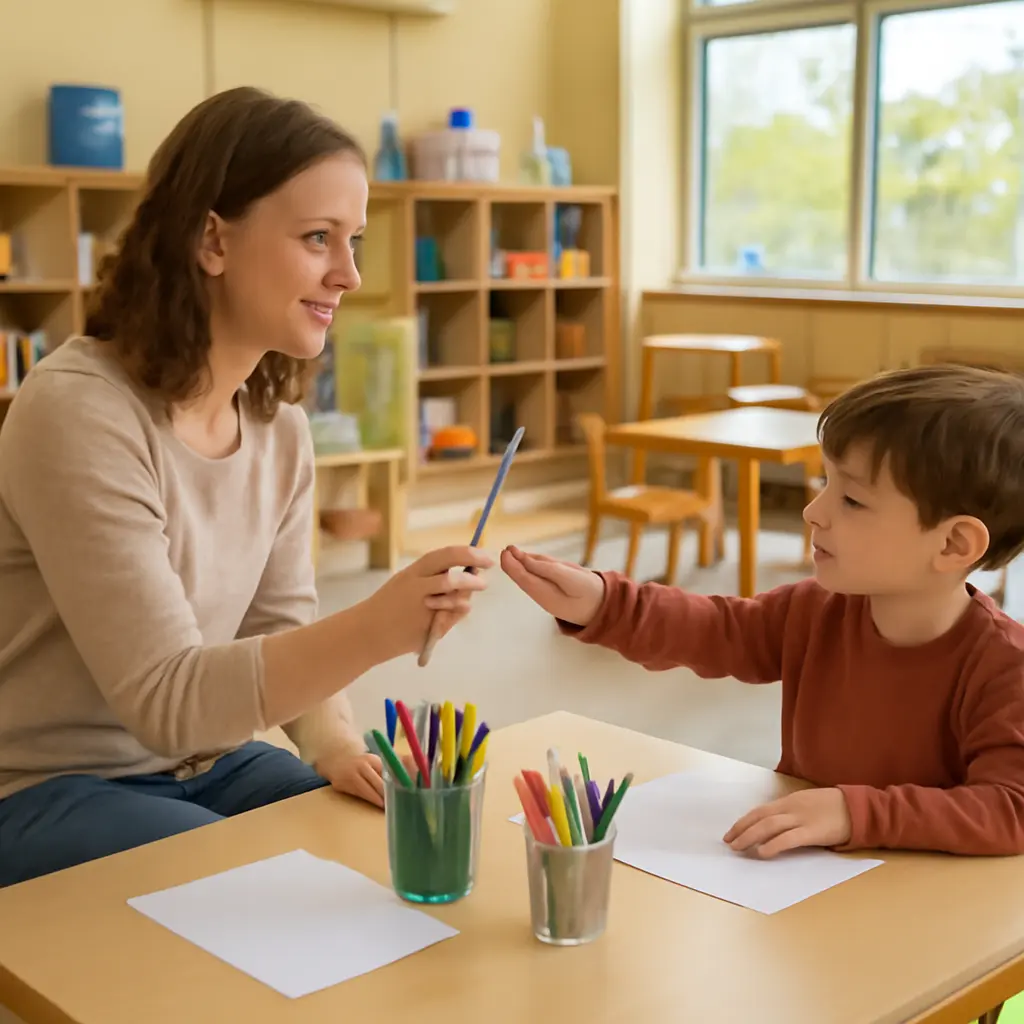
A preschool teacher can build a child’s confidence through small, steady actions rather than a stream of praise or instructions. In early childhood education, confidence is closely connected to children’s sense of belonging, growing independence, and belief that they can try a task. I watched a teacher nurture those qualities by waiting, offering choices, and acknowledging effort without taking over. That quiet approach reflects research on supportive adult-child relationships and developmentally appropriate teaching—and matters in a country where roughly 9 in 10 children ages 3 to 5 attend some form of nonparental care, according to the U.S. Census Bureau’s 2021 data.
Teacher responsiveness builds preschool confidence through calm presence
Confidence in preschool is not simply a child’s willingness to speak loudly or perform in front of others. It is a developing belief that one can participate, make choices, recover from mistakes, and seek help when needed. The National Association for the Education of Young Children (NAEYC) describes developmentally appropriate practice as a strengths-based approach that supports each child’s learning through an understanding of development, individuality, and social and cultural context.
In the classroom I observed, the teacher did not turn every uncertain moment into a lesson or demand an answer. She stayed nearby, watched carefully, and let children take the lead when they could. Her silence was not indifference: it gave children time to think while her posture and attention communicated that help was available. That combination—warmth without pressure—is one practical form of responsive teaching.
Attentive waiting gives children room to act
Attentive waiting means pausing before stepping in, while remaining observant and emotionally available. When one child struggled to fit a wooden piece into a puzzle, the teacher waited instead of finishing it for him. He rotated the piece, tried again, and looked up briefly. She met his glance with a small nod. The successful move belonged to him.
This kind of pause can support autonomy and problem-solving because the adult does not unintentionally signal that the child is incapable. Harvard University’s Center on the Developing Child describes “serve and return” interaction as a responsive exchange in which a child’s cue receives an attentive response. The response need not always be a question or explanation; a calm facial expression, a nod, or simply staying close can also sustain connection.
Specific acknowledgment recognizes effort without taking over
Specific acknowledgment names what a child did rather than assigning a broad label such as “smart” or “the best.” The teacher occasionally said brief things like, “You kept turning it,” or “You found a way to make space.” These observations made the child’s strategy visible without making adult approval the point of the task.
The distinction is consistent with NAEYC guidance that assessment and teaching should respond to children’s strengths, interests, and progress. A useful acknowledgment describes effort, persistence, or a decision the adult actually observed. It avoids exaggeration and leaves room for the child to decide whether to continue, change course, or ask for support.
Teacher autonomy support grows confidence through choice and manageable challenge
Autonomy support is the practice of respecting children’s agency while providing enough structure to keep activities safe and achievable. In preschool, it can take simple forms: letting a child choose between two materials, allowing time to attempt a task, or asking before helping. It is not the same as leaving children without guidance. The teacher remains responsible for setting limits and making the environment accessible.
The teacher I watched used short prompts rather than long directions. When a child hesitated at the art table, she placed two brushes within reach and waited. The child picked one and began. That small choice transformed an adult-led invitation into a child-owned decision.
Limited choices make participation approachable
A limited choice offers two or a few meaningful options, reducing the pressure of an open-ended question while preserving control. “Would you like the blue paper or the green paper?” can be easier for a hesitant preschooler to answer than “What do you want to do?” The choice should be genuine: both options need to be acceptable to the adult.
Choice is particularly useful during transitions, group activities, and unfamiliar tasks, when a child may be unsure how to join. The U.S. Centers for Disease Control and Prevention’s developmental guidance emphasizes that young children benefit from predictable routines and opportunities to practice everyday skills. A brief, consistent choice can make a routine more understandable without turning it into a test.
Scaffolding supports challenge without rescuing
Scaffolding is temporary support adjusted to a learner’s current need. A teacher might move a difficult material closer, demonstrate one step, or ask a concise question, then reduce help as the child becomes more capable. The aim is neither to remove every difficulty nor to insist that a child manage alone; it is to make the next step possible.
In the classroom, a child trying to zip a coat was given time to line up the clasp. The teacher held the bottom steady only after the child’s repeated attempts, then released it. This illustrates a practical measure of good scaffolding: support is specific and temporary, and the child retains as much ownership of the task as possible.
Teacher emotional safety helps confidence survive mistakes and hesitation
Emotional safety is a child’s experience of being accepted, protected, and treated respectfully while learning. It does not mean that every activity feels easy or that limits disappear. Rather, children can make mistakes, express uncertainty, and try again without being shamed. A teacher’s steady tone and predictable response help establish that climate.
The Center on the Developing Child at Harvard University explains that responsive relationships with caring adults are important to healthy development and help buffer the effects of stress. In a classroom, that principle becomes visible in ordinary moments: a teacher notices a child’s discomfort, offers proximity, and does not force participation before the child is ready.
Nonverbal cues communicate belonging
Nonverbal communication includes facial expression, eye contact, body position, gestures, and proximity. The teacher’s quiet confidence-building often came through these cues: she lowered herself to a child’s level, kept an open posture, and gave a small smile rather than calling attention to a hesitant child in front of the group.
These gestures are not a substitute for words when a child needs clear information or safety guidance. They are an additional channel of communication, especially for young children who may not yet have the language to explain what they need. A reassuring look can invite participation; a turned shoulder or rushed movement can unintentionally signal that the adult is unavailable.
Repair after frustration protects trust
Repair is the process of reconnecting after a difficult interaction. If a child becomes upset, or an adult responds too quickly, the teacher can acknowledge what happened, restore calm, and help the child re-enter the activity. For example: “That was frustrating. I’m here. Do you want to try again or take a break?”
This approach treats frustration as part of learning rather than proof of failure. It also respects individual differences: one child may want help, another a pause, and another a chance to try independently. Responsive support is not a rigid script but an effort to notice and adjust.
Teacher confidence-building practices can be noticed and strengthened
Quiet confidence-building can be easy to overlook because it does not always produce a dramatic moment. It is more visible as a pattern: children initiate activities, attempt manageable challenges, return after setbacks, and ask for help without fear. Families and educators can look for these behaviors rather than measuring confidence only by how often a child speaks in a group.
The U.S. Census Bureau reported that about 6.4 million children under age 6 were in nonparental care in 2021, illustrating how many young children spend time in settings where adult interactions shape daily experience. That figure describes attendance, not the quality of care or the effect of any single teaching technique. It does, however, underscore why responsive early-learning environments matter.
A simple observation chart can make progress visible
Teachers can record brief, neutral observations instead of relying on labels. A weekly chart might track whether a child initiated an activity, persisted after a difficulty, made a choice, or sought help. These notes can reveal emerging strengths and help adults decide whether to wait, offer a choice, adjust the task, or provide more direct support.
For example, an illustrative chart could show a child choosing a block activity on Monday, asking a peer to pass a piece on Wednesday, and rebuilding a fallen tower on Friday. The point is not to rank children or turn social-emotional development into a score. It is to notice change over time and share concrete examples with families.
Families can extend the same approach at home
Families can reinforce confidence by slowing down during everyday tasks, allowing children to try safe steps independently, and describing effort specifically. A child putting on shoes might need time rather than immediate correction. If help is needed, an adult can offer one manageable step, then let the child take over again.
Consistency does not require identical routines at home and school. It means communicating respect for the child’s effort, offering support without unnecessary pressure, and keeping expectations appropriate to the child’s age and abilities. Families should also share relevant context with teachers, including what helps a child feel secure or what situations make participation difficult.
Conclusion: Teacher presence, autonomy, and emotional safety build confidence
The teacher’s quiet approach showed that preschool confidence can grow through attentive waiting, specific acknowledgment, meaningful choices, and temporary scaffolding. Her nonverbal warmth helped children feel they belonged, while her restraint left space for them to act. Research on responsive relationships and developmentally appropriate practice supports the value of those everyday interactions, even though no single classroom moment can guarantee a particular outcome.
Educators can begin by observing before intervening, offering a manageable next step, and noticing how children respond. Families can look for the same small signs of agency and persistence at home. For further reading, explore NAEYC’s guidance on developmentally appropriate practice and the Center on the Developing Child’s materials on responsive relationships. The most telling measure may be simple: does the child feel safe enough to try?
Sources: National Association for the Education of Young Children, Developmentally Appropriate Practice, https://www.naeyc.org/resources/position-statements/dap/contents; Center on the Developing Child at Harvard University, Serve and Return, https://developingchild.harvard.edu/science/key-concepts/serve-and-return/; Center on the Developing Child at Harvard University, Supportive Relationships and Active Skill-Building Strengthen the Foundations of Resilience, https://developingchild.harvard.edu/resources/inbrief-resilience-series/; U.S. Census Bureau, Who’s Minding the Kids? Child Care Arrangements: 2021, https://www.census.gov/library/publications/2022/demo/p70-174.html; U.S. Centers for Disease Control and Prevention, Important Milestones: Your Child By Three Years, https://www.cdc.gov/ncbddd/actearly/milestones/milestones-3yr.html