
Play-based learning is a way of building knowledge and skills through purposeful play, and it does not have to mean adding a new activity or extra planning to the day. Educators can get more learning from play already happening by noticing children’s ideas, asking a focused question, and offering a small prompt or material that extends their thinking. This approach matters because play supports development across language, social-emotional skills, and problem-solving: a widely cited 2018 American Academy of Pediatrics clinical report describes play as central to healthy development and notes associations with improved executive function and language. The practical sections below explain what learning-rich play is, how to extend it in real time, how to adapt familiar routines, and how to tell whether learning is taking place.
Purposeful Play and Learning Gains
Purposeful play is play that remains engaging and active for children while also creating opportunities to practice or deepen meaningful knowledge and skills. The National Association for the Education of Young Children (NAEYC) describes developmentally appropriate practice as a strengths-based, play-based approach to joyful, engaged learning. In this view, “purposeful” does not mean turning every game into a lesson or directing every move. It means educators use their knowledge of children and learning goals to make responsive choices during play.
Useful forms include child-led free play, guided play, and playful routines. In free play, children choose the activity and direct it. In guided play, adults shape the environment or add timely support while children retain agency. Playful routines incorporate learning into everyday transitions and tasks. These approaches can overlap; the right balance depends on children’s ages, interests, and needs.
A 2022 meta-analysis published in Child Development compared guided play with direct instruction and free play across 39 studies involving 17 skills. It found advantages for guided play in some areas, including early mathematics and shape knowledge, while results varied by outcome. The implication is not that guided play wins in every situation, but that well-timed adult support can help children make specific learning gains without taking over the play.
Guided Play: Support Without Taking Control
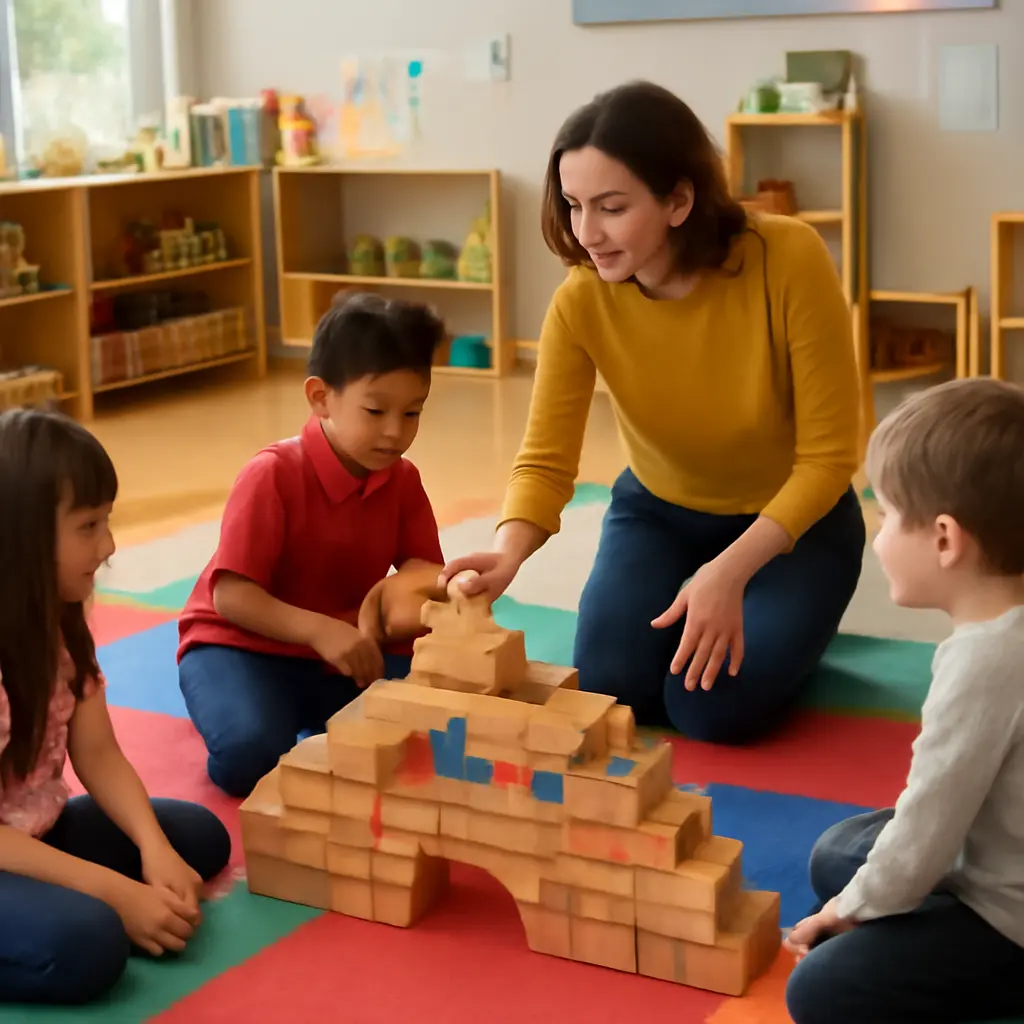
Guided play combines a learning intention with children’s active choice. An educator might aim to encourage comparison, then join a block-building scene with a prompt such as, “Which tower is taller? How could we check?” The question introduces a mathematical idea but leaves the child free to decide what to build and how to investigate it.
Free Play: Observe Before Intervening
Free play gives children room to choose goals, roles, and materials. Adults can protect uninterrupted play, observe what children are exploring, and step in when an invitation, resource, or safety response would help. Observation is not passive: noticing repeated interests, misunderstandings, or peer negotiations gives educators useful information for their next response.
Playful Routines: Learning in the Day Already Planned
A routine becomes playful when children can participate, make choices, and think aloud. During cleanup, for example, children can sort objects by type, count how many fit in a basket, or describe where items belong. These brief moments do not replace a planned lesson; they make ordinary classroom activity richer without requiring a separate preparation period.
Responsive Teaching Turns Existing Play Into Learning
Responsive teaching is the practice of noticing what a child is doing and responding in a way that advances the child’s thinking. The Harvard Graduate School of Education’s Center on the Developing Child describes “serve and return” as the back-and-forth interaction in which a child communicates through words, gestures, or sounds and an adult responds. This exchange is relevant to play because a brief, attentive response can sustain engagement and create a chance to practice language, reasoning, or social skills.
A simple sequence is: observe, connect, and extend. Observe the child’s action without rushing to judge it. Connect by naming the child’s idea or joining the play respectfully. Extend with a question, a new word, or a small challenge. This sequence can happen in seconds and does not require a new lesson plan.
Use Open Questions to Invite Reasoning
An open question allows more than one reasonable response and encourages children to explain their thinking. Instead of “Is this the biggest block?” try “How could we find out which block is biggest?” In pretend play, “What might the customer need next?” can prompt planning and conversation. Ask one question, then allow wait time; rapid questioning can make play feel like a quiz.
Model Language and Introduce Useful Vocabulary
Educators can add precise words while keeping the child’s idea at the center. A child rolling a toy car down a ramp might hear, “It moved faster when the ramp was steeper.” In a dramatic-play shop, words such as “total,” “receipt,” or “customer” can enrich play naturally. The goal is to make language available, not require children to repeat every term.
Offer a Small Challenge or a New Material
A small challenge nudges play just beyond what a child is already doing. If a bridge keeps falling, an adult might ask, “What could make the middle stronger?” or offer a different kind of block. A useful prompt preserves the child’s ownership: provide one clue or material, then let the child test it. Too many additions can interrupt concentration rather than deepen it.
Everyday Materials Support Multiple Learning Goals
Open-ended materials—items that can be used in several ways—make it easier to build learning into play without preparing a new activity. Blocks, paper, containers, fabric, and safe recycled objects can support different kinds of exploration depending on children’s ideas. The National Association for the Education of Young Children emphasizes that children learn through active engagement with people and materials, while educators make intentional choices about the environment and their interactions.
Blocks and Loose Parts for Early Mathematics and Science
Building invites children to compare height, length, balance, and shape. An educator can encourage prediction—“What do you think will happen if we add one more block?”—then help children notice the result. A quick verbal comparison or a photograph of a construction can make learning visible without setting up a formal measurement station.
Pretend Play for Language and Social Learning
Pretend play gives children reasons to negotiate roles, explain plans, and use new vocabulary. If children are playing restaurant, an educator can join briefly as a customer who needs help choosing, or provide a notepad already used elsewhere in the room. Children practice communication and perspective-taking while keeping the scenario theirs.
Art and Construction for Planning and Persistence
Drawing, making, and construction often involve choosing an idea, testing materials, and revising a plan. Rather than correcting a child’s work, ask, “What are you trying to make?” or “What might you try next?” These prompts support planning and persistence while respecting different ways of representing an idea.
Observation Makes Learning Gains Visible
Observation is a quick way to check whether an adult’s response is helping. Look for evidence such as a child explaining a choice, trying a new strategy, using a newly introduced word, counting or comparing, or returning to a difficult task. The National Research Council’s 2001 report Eager to Learn highlights the importance of knowledgeable adults who observe children’s understanding and use that knowledge to guide learning experiences.
A short note can capture more than a lengthy record: “Maya tested two bases, then chose the wider one after her tower tipped.” This documents a strategy and suggests a next step, such as offering opportunities to compare stability in another context. A brief observation is not a standardized assessment, but it can help educators make responsive decisions and share specific examples with families or colleagues.
Look for Process, Not Only a Finished Product
A completed tower or picture does not reveal everything a child learned. Notice the process: whether the child planned, experimented, revised, explained, collaborated, or persisted. These behaviors often show the learning more clearly than the final object.
Adjust the Prompt to the Child
If a child is already confidently solving a problem, increase the challenge or invite the child to explain a strategy. If the child seems frustrated or disengaged, simplify the prompt, offer a choice, or step back. Responsive support is calibrated: enough to open a next step, not so much that the adult does the thinking.
A No-Extra-Prep Example: The Block-Area Bridge
Consider children already building with classroom blocks. An educator notices that their bridge keeps collapsing. Without preparing a new activity, the educator asks what the bridge needs to hold, invites a prediction, and offers a word such as “support.” Children test a wider base, compare results, and explain what changed. The same play can involve engineering, measurement language, collaboration, and persistence.
The educator can then make a quick mental or written note about what each child tried. If children lose interest, the adult lets the play move on; if they remain engaged, one further question may deepen the investigation. The key is not to prolong the activity at all costs, but to respond to the learning opportunity that is already present.
Conclusion: Make One Small, Responsive Move
Purposeful play, responsive teaching, open-ended materials, and brief observation work together to create learning gains without extra preparation. Guided play can support specific outcomes, while child-led play and playful routines provide valuable opportunities for agency, language, social development, and exploration. The practical next step is simple: during a familiar play period, observe one child’s idea, respond with one useful question or word, and notice what the child does next. For further guidance, educators can consult NAEYC’s developmentally appropriate practice resources and the American Academy of Pediatrics report on the power of play.
Sources: Yogman, M. et al., “The Power of Play: A Pediatric Role in Enhancing Development in Young Children,” Pediatrics, 2018, https://doi.org/10.1542/peds.2018-2058; Skene, K. et al., “Can Guidance During Play Enhance Children’s Learning and Development in Educational Contexts? A Systematic Review and Meta-Analysis,” Child Development, 2022, https://doi.org/10.1111/cdev.13730; National Association for the Education of Young Children, Developmentally Appropriate Practice Position Statement, https://www.naeyc.org/resources/position-statements/dap/contents; Center on the Developing Child at Harvard University, Serve and Return, https://developingchild.harvard.edu/science/key-concepts/serve-and-return/; National Research Council, Eager to Learn: Educating Our Preschoolers, 2001, https://doi.org/10.17226/9745.