
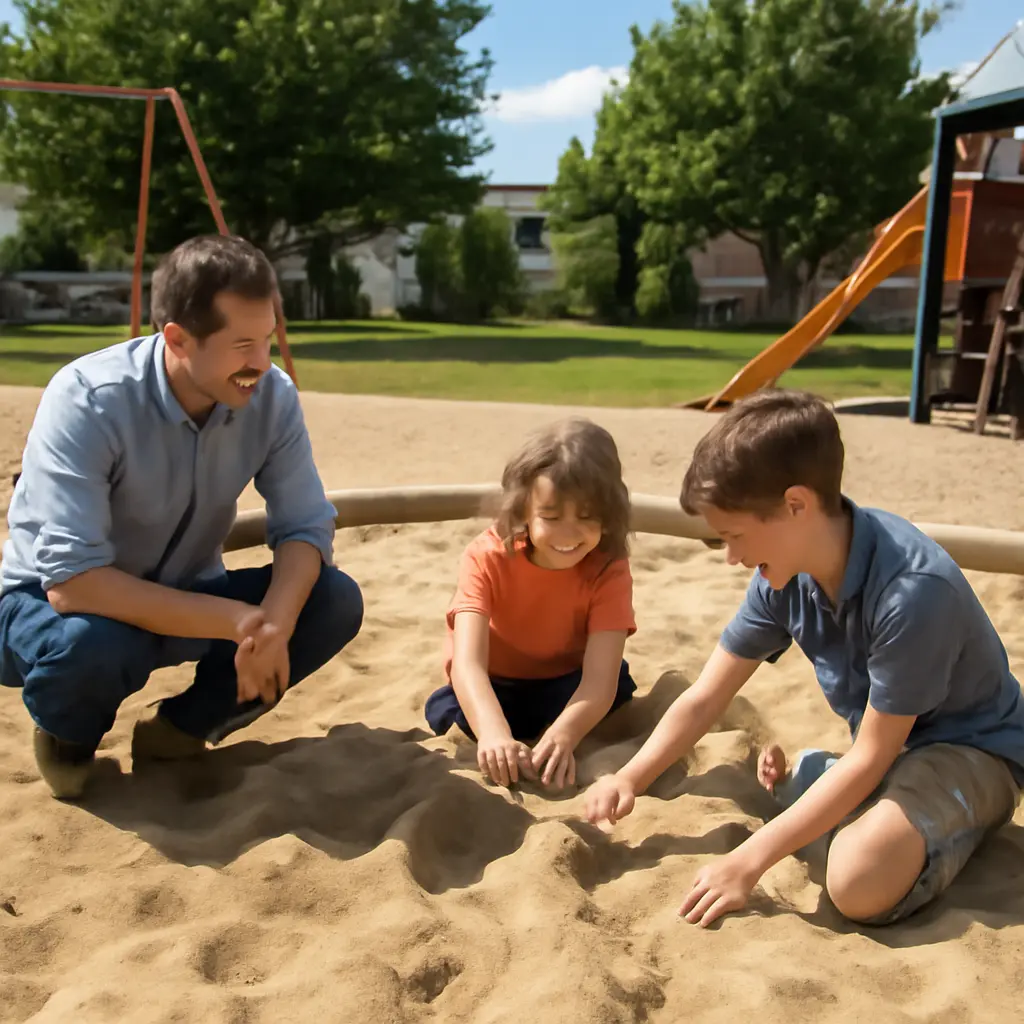
Age Differences and Cooperative Play: What Happens When a Preschooler and an Eight-Year-Old Share a Sandbox?
A preschooler and an eight-year-old can play together in a sandbox, but they bring different abilities, interests, and expectations to the same space. Their interaction is a form of mixed-age play: the younger child may explore through sensory activity and imitation, while the older child can contribute planning, storytelling, and more advanced construction. The experience can support communication and cooperation when adults provide a safe, flexible setting without requiring the children to play in the same way. The National Association for the Education of Young Children (NAEYC) describes play as central to children’s learning, while research on mixed-age interaction points to opportunities for modeling and shared problem-solving. These benefits depend on age-appropriate supervision, clean sand, and attention to the children’s individual needs.
Mixed-Age Sandbox Play: Definition and Developmental Value
Mixed-age play is play involving children at different developmental stages. There is no single formal definition that applies to every setting; in early-childhood practice, the term generally describes shared play among children whose ages, skills, or experience differ. A preschooler and an eight-year-old are likely to differ in language, coordination, attention, and capacity for planning, but those differences do not prevent meaningful play. They shape how the activity unfolds.
The U.S. Centers for Disease Control and Prevention lists ages three to five as the preschool developmental period and notes that development varies among children. The American Academy of Pediatrics (AAP) likewise emphasizes that play supports physical, social-emotional, language, and cognitive development. A sandbox makes these domains visible: digging and pouring exercise motor skills; negotiating tools practices communication; and building a shared structure invites planning and imaginative thinking.
Parallel Play and Shared Attention
Parallel play occurs when children play near one another, sometimes using similar materials, without yet coordinating a common goal. It is a normal way for a younger child to join an older child’s activity: the preschooler might fill a cup beside the eight-year-old’s moat before either child agrees to build together. Shared attention—looking at, talking about, or responding to the same object—can provide a bridge from side-by-side activity to cooperation.
Adults can support this transition by describing what each child is doing or offering an open-ended prompt, such as, “Where could the water go next?” The aim is not to demand a finished group project. Children may move between playing alone, alongside one another, and together during the same session.
Imitation, Modeling, and Peer Learning
Modeling is learning by watching another person demonstrate an action. An eight-year-old might show how to pack damp sand into a mold, make a tunnel, or take turns with a scoop. The preschooler can copy the action, adapt it, or simply watch. The older child may also benefit by explaining a plan, breaking a task into steps, and adjusting the explanation to a younger partner.
These possibilities should be treated as opportunities, not guaranteed outcomes. A child’s willingness to imitate or teach depends on temperament, familiarity, interest, and the moment. Adults can encourage reciprocal participation by inviting both children to suggest ideas and by avoiding the assumption that the older child must always lead.
Sandbox Cooperation: How Age Differences Shape Interaction
Cooperative sandbox play happens when children coordinate their actions toward a shared activity, such as making a road or filling a bucket together. At ages three to five, children are still developing the language and self-regulation needed to negotiate roles and wait for turns; an eight-year-old may be more capable of organizing a multi-step game. The age gap can therefore create useful complementary roles, but it can also lead to mismatched expectations or unequal control of the materials.
Shared Goals and Flexible Roles
A shared goal gives children a reason to coordinate without requiring identical skills. One child might dig a channel while the other pours water, or the preschooler might gather pinecones as the older child designs a pretend campsite. Flexible roles let each child contribute at a comfortable level and can be changed as interests shift.
Adults can help establish a simple plan—“You choose where the road goes, and your friend can find stones for the edges”—then step back if the children are managing well. If one child repeatedly takes over, an adult can invite the quieter child’s idea or offer separate tools. The purpose is balanced participation, not a perfectly equal division of every task.
Language, Conflict, and Turn-Taking
Sandbox materials are attractive precisely because they are open-ended, so disagreements over a shovel, bucket, or construction plan are predictable. Conflict can give children practice expressing preferences and hearing another person’s point of view. A preschooler may need an adult to put the problem into words—“You both want the blue bucket”—and help identify a workable option, such as taking turns or finding another container.
The AAP’s guidance on play highlights its role in developing social and emotional skills, including communication and relationships. That does not mean adults should leave children to resolve every dispute alone. Intervene when a child is unsafe, distressed, persistently excluded, or unable to communicate what they need; otherwise, brief coaching can preserve children’s ownership of the play.
When Interests or Abilities Do Not Match
A mismatch occurs when the children want different kinds of play or have different capacities for a task. The older child may want to build a detailed fort while the preschooler prefers pouring sand repeatedly. Both activities can coexist. Offering adjacent play options, a larger shared project with several roles, or a short break can prevent the assumption that success means uninterrupted collaboration.
Children also vary widely within each age group. Developmental milestones are general guides, not a test that determines whether a child can participate. Adults should adapt expectations to the children in front of them, including any sensory, communication, mobility, or support needs.
Safe Sandbox Play: Hygiene, Supervision, and Inclusion
A good shared-play experience depends on more than social skills. Sand can contain debris or animal waste, and loose materials can create hazards if children put them in their mouths or throw them. The U.S. Consumer Product Safety Commission recommends maintaining playground equipment and surfacing to reduce injury risks; the CDC’s Healthy Swimming guidance also advises keeping people with diarrhea out of recreational water, a relevant precaution when children bring water into a shared play area.
Clean Sand and Hand Hygiene
Clean sandbox practice means checking the play area, preventing contamination, and washing hands afterward. Cover a home sandbox when it is not in use, inspect sand for animal waste, sharp objects, or other debris, and replace sand that is contaminated. The CDC advises handwashing with soap and water after contact with sand or soil and before eating.
Children should avoid eating sand and should keep sand away from their faces. If a child has an open wound, a health condition that increases infection risk, or persistent symptoms after exposure, caregivers should follow medical advice. A quick visual check before play and handwashing afterward are simple steps that make shared use safer.
Age-Appropriate Supervision and Boundaries
Supervision means staying close enough to notice hazards and respond, while allowing children room to direct their play. Adults should set clear rules: sand stays low and is not thrown; tools are used for digging rather than hitting; and water is carried in manageable amounts. The preschooler may need closer support with small objects, mouthing, or impulsive actions, while the older child may need reminders that a younger playmate cannot necessarily follow complex rules.
A practical rule is to intervene according to risk rather than age alone. Stop unsafe behavior immediately, help children repair a conflict when needed, and otherwise allow their play to develop. If either child no longer wants to participate, respect that choice rather than pressuring them to continue together.
Inclusive Materials and Accessible Play
Inclusive sandbox play offers multiple ways to take part. Large-handled scoops, lightweight containers, stable seating, and tools placed within reach can support different motor abilities. Picture choices, simple verbal prompts, and predictable routines can help children who benefit from communication support. A child can contribute by choosing materials, directing a partner, touching sand, or observing before joining in.
The goal is meaningful access, not making every child perform the same action. When adults ask what helps a child participate and provide choices, mixed-age play can accommodate different strengths without turning the older child into a caregiver or the younger child into a passive follower.
A Practical Sandbox Example: Building a Shared River
Consider a preschooler who wants to pour water and an eight-year-old who wants to construct a landscape. An adult might suggest making a river. The older child can outline a route, the preschooler can pour small amounts of water, and both can place stones along the edge. If the younger child changes the plan, the older child can choose whether to adapt it or make a separate section. This arrangement connects a shared goal with flexible roles and leaves room for independent ideas.
A simple observation chart can help caregivers notice whether the setup is working:
- Participation: Do both children have a way to contribute?
- Communication: Are they exchanging ideas, gestures, or materials?
- Balance: Does either child control the activity or tools continuously?
- Well-being: Do both appear engaged, safe, and comfortable?
- Adaptation: Can the activity change when one child’s interest shifts?
This is an observation aid, not a validated developmental assessment or a research statistic. Its purpose is to help an adult adjust the environment rather than judge the children. If one child is disengaged, simplifying the project, offering parallel play, or ending the activity may be the best response.
Conclusion: Supporting Mixed-Age Sandbox Play
When a preschooler and an eight-year-old share a sandbox, their age difference can create opportunities for imitation, communication, and cooperation—but only when the play fits both children. Parallel activity can become shared attention; flexible roles can support a common goal; and calm adult coaching can help with conflict and turn-taking. Clean sand, handwashing, appropriate supervision, and accessible materials provide the foundation for safe participation.
Caregivers and educators can begin with open-ended materials, a few clear safety rules, and room for children to play together or separately. Observe what each child enjoys, support their ideas without taking over, and consult trusted pediatric and early-childhood guidance for further information about development, play, and safety.
Sources: National Association for the Education of Young Children, “The Importance of Play,” https://www.naeyc.org/resources/topics/play; Centers for Disease Control and Prevention, “Developmental Milestones,” https://www.cdc.gov/act-early/milestones/; American Academy of Pediatrics, “The Power of Play: A Pediatric Role in Enhancing Development in Young Children,” Pediatrics, 2018, https://publications.aap.org/pediatrics/article/142/3/e20182058/38649/The-Power-of-Play-A-Pediatric-Role-in-Enhancing; U.S. Centers for Disease Control and Prevention, “About Handwashing,” https://www.cdc.gov/clean-hands/about/; U.S. Consumer Product Safety Commission, Public Playground Safety Handbook, https://www.cpsc.gov/s3fs-public/325.pdf