
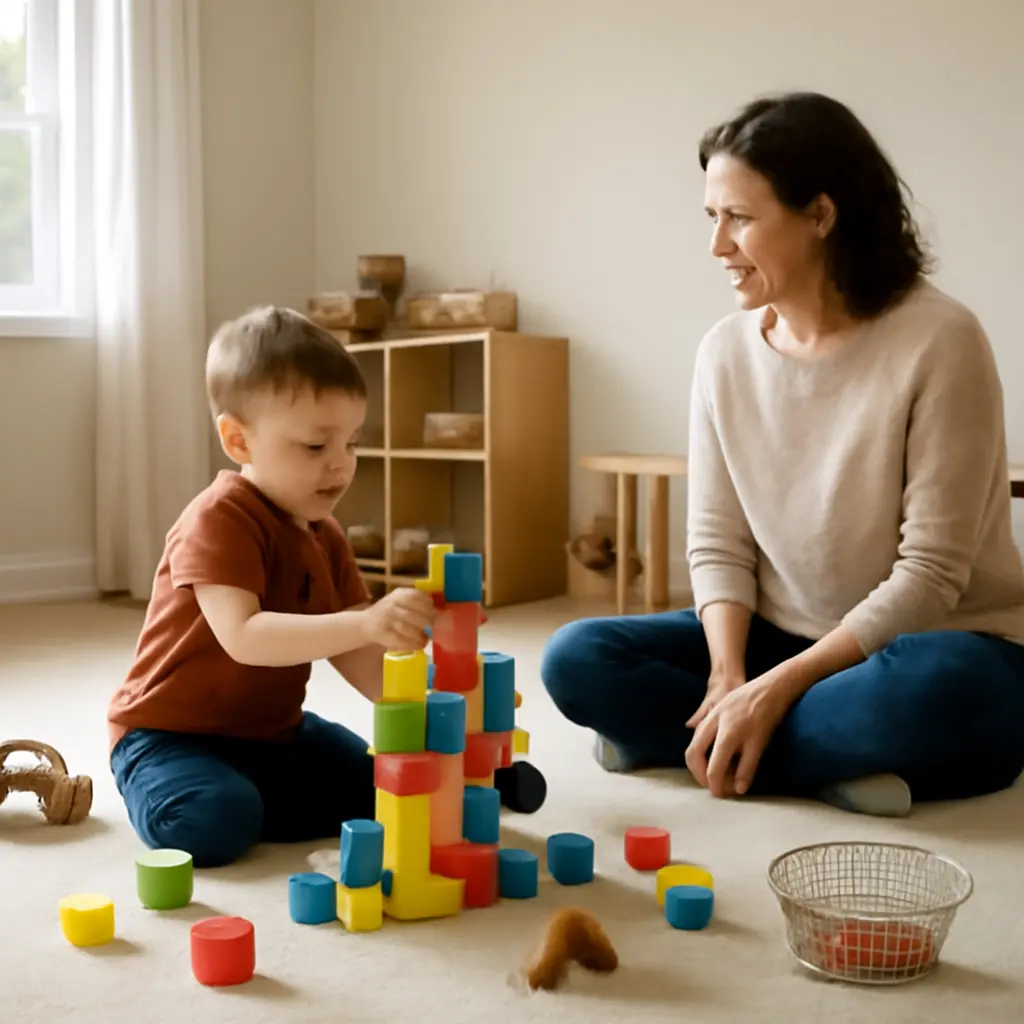
Play is a child-led way of exploring, practicing skills, and making sense of the world; school readiness is the developing set of abilities that helps children participate in learning and classroom routines. Common play mistakes that can slow this development include replacing play with excessive instruction, limiting children’s choices, expecting skills too early, and overlooking social or physical play. These patterns matter because readiness involves more than academic knowledge: the Centers for Disease Control and Prevention notes that developmental milestones include communication, movement, thinking, and social-emotional skills, while the American Academy of Pediatrics describes play as important to healthy development. Avoiding these mistakes does not require expensive toys or elaborate lessons—responsive interaction, time, and varied play opportunities are strong foundations.
How play mistakes affect school readiness development
School readiness is not a single score or a requirement that every child master identical skills at the same age. The National Association for the Education of Young Children (NAEYC) frames developmentally appropriate practice around children’s common developmental patterns, individual differences, and social and cultural contexts. In practical terms, readiness includes emerging language, self-regulation, curiosity, problem-solving, motor coordination, and the ability to engage with other people.
Play supports these connected abilities through several forms: pretend play, constructive play, physical play, exploratory or sensory play, and social games. The American Academy of Pediatrics’ 2018 clinical report, “The Power of Play,” explains that play can support executive function, language, social-emotional development, and relationships. The report also emphasizes the value of adults’ engaged, supportive interaction—not constant direction.
The scale of early development makes these opportunities important. UNICEF’s 2017 report, “Early Moments Matter for Every Child,” estimated that 43% of children under five in low- and middle-income countries were at risk of not reaching their developmental potential because of poverty and stunting. That figure describes broad structural risks, not the effect of any one play habit. It does, however, underline why supportive relationships and enriching early experiences deserve attention.
Confusing school readiness with early academic drilling
Academic drilling means repeatedly practicing narrow skills—such as letter naming or worksheets—while leaving little time for exploration, conversation, movement, and imaginative play. Early exposure to books, numbers, and writing can be enjoyable and useful; the problem is treating formal instruction as a substitute for the broader experiences that help children use those skills.
For example, a child who sorts toy animals can compare size, count objects, describe differences, and invent a story. An adult can enrich the play by asking, “Which group has more?” or “Where might the animals go?” This keeps early math and language connected to curiosity and meaning rather than turning every activity into a test.
Overdirecting play and removing children’s choices
Overdirected play occurs when adults choose every action, correct every deviation, or insist that a child use materials in one approved way. Guidance is sometimes helpful, particularly for safety or when a child asks for help, but constant adult control can limit opportunities to plan, make decisions, persist, and revise ideas.
A more balanced approach is to follow the child’s focus, observe before stepping in, and offer a prompt or material when it extends the play. If a block tower falls, for instance, an adult might ask, “What could make the bottom stronger?” rather than rebuilding it immediately. The child gets room to test a solution while still benefiting from supportive interaction.
How play mistakes limit language and social-emotional skills
Language and social-emotional development grow through repeated exchanges: children express ideas, listen, negotiate, imitate, and repair misunderstandings. Play gives these skills a meaningful setting. Pretend scenarios invite children to use new words and take perspectives; shared games create chances to wait, cooperate, and cope with frustration. When play is consistently isolated, rushed, or controlled, children may have fewer natural opportunities to practice these interactions.
Replacing conversation with passive screen use
Passive screen use is viewing content without much conversation, movement, or interaction. Digital media can be part of family life, but it is less likely to provide the back-and-forth exchanges found in shared play when a child watches alone for long stretches. The American Academy of Pediatrics recommends that families consider the child’s age, content, and context, and make room for sleep, physical activity, relationships, and other healthy routines.
A practical alternative is to watch or play together when screens are used, then connect the content to an offline activity: build a scene with blocks, draw a character, or act out what happened. The goal is not to label every screen experience harmful, but to avoid letting passive media displace conversation, hands-on exploration, and play with other people.
Interrupting pretend play or correcting every mistake
Pretend play is the use of imagination to represent people, objects, or situations. A cardboard box can become a bus; a child can act as a shopkeeper or doctor. These scenarios let children experiment with language, roles, flexible thinking, and everyday social rules. Adults may support the story by joining in briefly or supplying open-ended materials, but taking over the plot can narrow the child’s practice.
Correction also has its place, especially when a child’s safety or another person’s wellbeing is involved. But correcting harmless details—such as insisting that a pretend cup must be used only as a cup—can shut down experimentation. Instead, adults can ask open questions, reflect the child’s idea, and let the story develop.
Avoiding peer play and turn-taking practice
Peer play helps children practice joining a group, sharing materials, negotiating rules, and managing small conflicts. Children do not need to be forced into group play at every opportunity, and solitary play can be valuable. The concern is a persistent lack of chances to interact with peers or supportive adults, especially when a child wants that interaction but needs help entering it.
Adults can make social play easier by arranging short, low-pressure activities with a shared purpose, such as building a road together or taking turns rolling a ball. When disagreements arise, guide children to name the problem and consider options rather than resolving every minor dispute for them. If communication or social concerns persist, discuss them with a pediatrician or early-childhood professional.
How play mistakes restrict physical, sensory, and problem-solving development
Movement and hands-on exploration are not separate from learning. They help children develop coordination, spatial awareness, persistence, and the ability to test cause and effect. The World Health Organization’s 2019 guidelines recommend that children under five have regular physical activity throughout the day and limit sedentary time; specific recommendations vary by age. Active play can be as simple as walking, dancing, climbing safely, carrying objects, or playing outdoors.
Restricting active and outdoor play unnecessarily
Active play includes movement such as running, jumping, balancing, and throwing. Outdoor play can add changing surfaces, natural objects, and space for larger movements. Excessive restrictions on safe movement—such as expecting young children to sit still for long periods—may reduce opportunities to build motor skills and practice self-regulation through physical activity.
Safety matters, but it can be supported through age-appropriate boundaries rather than eliminating movement. Choose a safe area, supervise according to the child’s abilities, and offer manageable challenges. A low balance beam or a path over cushions, for example, invites practice while allowing an adult to adjust the difficulty.
Providing toys with only one correct use
Open-ended materials—such as blocks, playdough, cardboard, crayons, and reusable household objects—can be used in many ways. They encourage children to make plans, test ideas, and adapt when something does not work. By contrast, toys that dictate a single sequence or outcome may offer less room for child-led invention, although structured toys can still be enjoyable and useful in moderation.
A simple example is building with blocks. A child may make a bridge, knock it down, and try a wider base. That process naturally involves observation, prediction, and revision. Adults can extend it with questions such as, “What changed when you added another block?” without demanding a particular answer.
Expecting perfection instead of allowing trial and error
Trial and error is the process of trying an approach, noticing the result, and adjusting. When adults rush to prevent every failure or praise only correct results, children may have fewer chances to practice persistence and flexible problem-solving. Encouragement can focus on effort and strategy: “You tried a different way,” or “What might you change next?”
This does not mean leaving a child unsupported when a task is overwhelming. Break the challenge into manageable steps, model a strategy if needed, and let the child take the next turn. The aim is a balance between useful assistance and enough independence to learn from experience.
How to support play-based school readiness
A readiness-supportive play environment does not need costly equipment. It needs time, safe space, responsive adults, and materials that invite children to explore. NAEYC’s developmentally appropriate practice guidance stresses that learning should reflect children’s strengths, interests, and developmental needs, rather than rely on a one-size-fits-all approach.
- Offer a mix of pretend, constructive, physical, sensory, and social play.
- Let children lead when possible; join in to model language or extend an idea without taking control.
- Use everyday materials such as boxes, washable art supplies, blocks, and safe household objects.
- Make room for conversation, outdoor movement, rest, and unstructured play in daily routines.
- Notice each child’s interests and abilities, and adapt activities so they are challenging but achievable.
A useful real-world example is a pretend grocery store. Children can sort empty food containers, make signs, count play money, take turns being customers, and talk about what they are “buying.” One activity brings together language, early math, social cooperation, and imaginative thinking. Adults can follow the children’s ideas while adding a word, question, or small challenge when it fits naturally.
The text-based checklist below summarizes the contrast: readiness-supportive play is varied, responsive, active, and child-involved; play that may be less supportive is consistently passive, overly controlled, narrowly academic, or limited in social and physical opportunities. These are patterns to reflect on, not a diagnostic test.
- Supportive: children have choices, adults respond warmly, and materials can be used in different ways.
- Potential concern: adults direct every step, children have little time to explore, or mistakes are routinely corrected before children can try again.
- Supportive: daily routines include conversation, movement, peer interaction, and rest.
- Potential concern: screens or worksheets regularly replace hands-on play and responsive interaction.
Conclusion: avoid common play mistakes to strengthen school readiness
Play supports school readiness when it gives children opportunities to communicate, move, imagine, solve problems, and interact with others. The most common pitfalls are not isolated choices but repeated patterns: overemphasizing drills, taking over children’s play, relying on passive screen use, restricting safe movement, and expecting flawless performance. Research and guidance from the American Academy of Pediatrics, NAEYC, UNICEF, and the World Health Organization all point to the value of developmentally responsive experiences and supportive relationships.
Families and educators can start with small changes: follow a child’s interests, offer open-ended materials, make time for movement and conversation, and allow manageable challenges. Readiness develops over time and varies among children. If there are ongoing concerns about a child’s development, speak with a pediatrician or qualified early-childhood professional and ask about developmental screening and local support services.
Sources: American Academy of Pediatrics, “The Power of Play: A Pediatric Role in Enhancing Development in Young Children,” Pediatrics, 2018, https://publications.aap.org/pediatrics/article/142/3/e20182058/38649/The-Power-of-Play-A-Pediatric-Role-in-Enhancing; Centers for Disease Control and Prevention, “Developmental Milestones,” https://www.cdc.gov/ncbddd/actearly/milestones/; National Association for the Education of Young Children, “Developmentally Appropriate Practice,” https://www.naeyc.org/resources/position-statements/dap; UNICEF, “Early Moments Matter for Every Child,” 2017, https://www.unicef.org/reports/early-moments-matter-every-child; World Health Organization, “Guidelines on Physical Activity, Sedentary Behaviour and Sleep for Children under 5 Years of Age,” 2019, https://www.who.int/publications/i/item/9789241550536.