
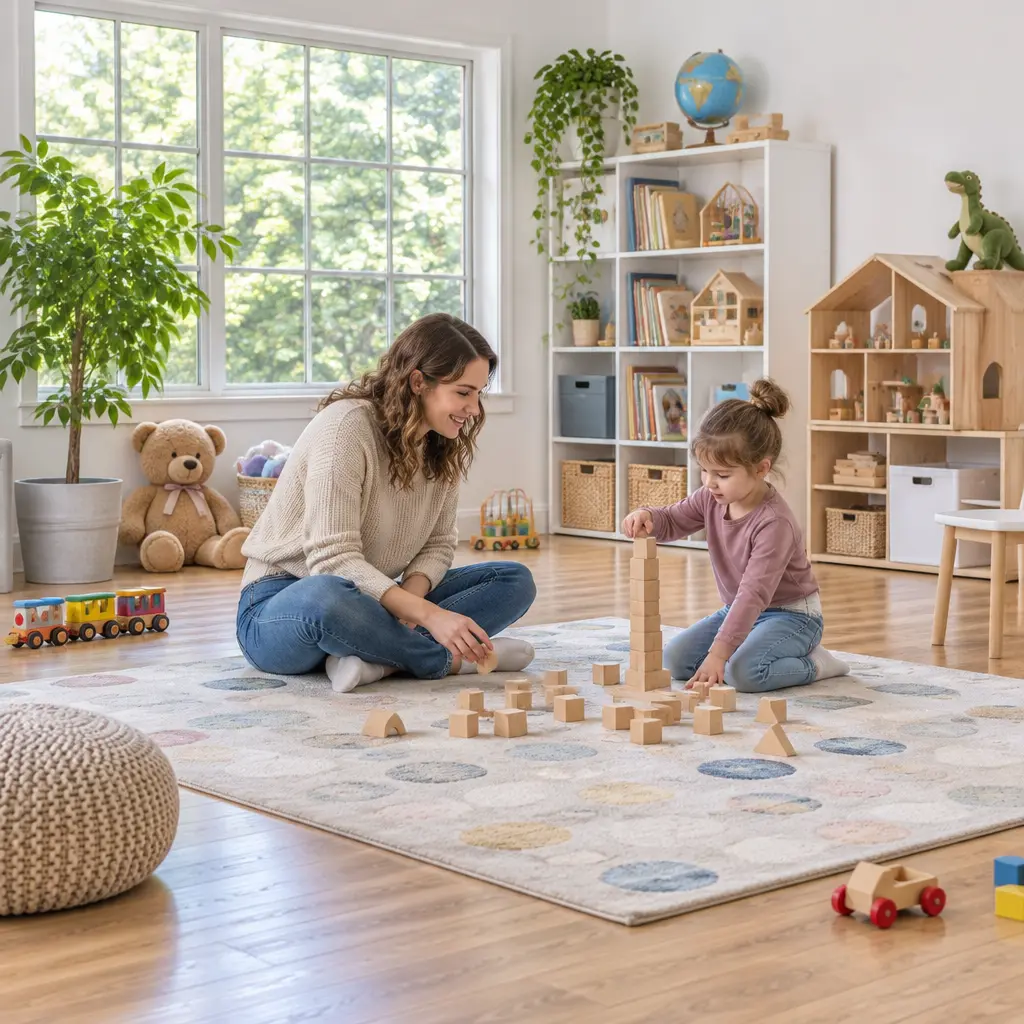
Talking with your child during play means joining their attention and responding to what they are doing without directing every move. The goal is not to stay silent or avoid teaching; it is to follow the child’s lead, describe what you notice, and leave room for them to think, communicate, and choose. This approach fits with responsive caregiving guidance from organizations such as the American Academy of Pediatrics (AAP) and the Harvard Center on the Developing Child: warm, back-and-forth interaction supports children’s learning and relationships, while play itself gives children opportunities to practice language, problem-solving, and self-regulation. The practical balance is simple: observe first, comment or imitate, wait, and offer help only when it is welcome or needed.
Responsive Play Talk Supports Child-Led Learning
Responsive play talk is a way of interacting in which an adult notices a child’s focus and responds in a warm, relevant way instead of repeatedly redirecting the activity. The AAP’s clinical guidance on play describes play as important to healthy development and recommends that caregivers make time for play and follow children’s interests. Harvard’s Center on the Developing Child uses the term “serve and return” for the back-and-forth exchanges in which a child communicates through sounds, gestures, words, or actions and an adult responds.
These ideas are related but not identical: child-led play describes who guides the activity, while serve-and-return describes the responsive exchange within it. Together, they suggest a useful practice—stay emotionally available without turning play into a lesson plan. A parent can name what the child is doing, copy a sound, answer a question, or offer a small extension, then pause so the child can decide what happens next.
Follow the child’s focus
Following a child’s focus means attending to the toy, action, or idea that currently has their interest. If a child is lining up toy animals, an adult might say, “You’ve made a long line,” rather than immediately suggesting a pretend zoo. This kind of comment acknowledges the child’s plan and gives them language connected to what they are already noticing.
The AAP notes that play can support social-emotional, cognitive, language, and self-regulation skills. That does not mean every play moment needs an educational objective. A child’s concentration and enjoyment are also meaningful; adults can support learning by being attentive rather than constantly testing, correcting, or asking questions.
Use serve-and-return conversation
Serve-and-return is a back-and-forth interaction: a child offers a “serve” through a look, gesture, word, sound, or action, and the adult responds in a way that recognizes it. Harvard’s Center on the Developing Child explains that these responsive exchanges help build the foundations for communication and social connection. The exchange need not be verbal. Smiling when a baby looks toward you, imitating a toddler’s drumbeat, or answering a preschooler’s pretend-play idea can all count.
A helpful response is specific and connected. If a child pushes a car down a ramp, try, “It went all the way to the bottom!” Then wait. If the child looks at you or repeats the action, respond again; if they turn away, let the moment end. The point is mutual attention, not keeping a conversation going at all costs.
Playful Language Builds on What the Child Says and Does
Language-supportive play talk adds words to a child’s experience without taking control of the play. Related strategies include describing actions, imitating, expanding a child’s words, asking occasional open-ended questions, and allowing pauses. These approaches are often used in parent coaching and early-language support because they create opportunities for children to hear language in context and contribute at their own level.
Describe more than you quiz
A description tells the child what you notice: “You’re pressing the blue dough flat,” or “The teddy is tucked under the blanket.” A quiz asks for a known answer: “What color is that?” or “What is the teddy doing?” Questions can be enjoyable and useful, especially when a child invites them, but a steady stream may make play feel like a test. Try alternating a question with several observations, comments, or moments of quiet.
Descriptions also make room for children who are not yet speaking much. They can respond with a look, movement, sound, sign, or word. For a multilingual child, adults can use the language in which they communicate most naturally; rich, comfortable interaction matters more than forcing a particular language during play.
Imitate, then expand
Imitating means joining a child’s action or sound in a respectful way. If a toddler taps a block twice, the adult can tap twice too. Expanding means adding a little language to the child’s contribution without demanding repetition. If the child says “big truck,” an adult might answer, “Yes, the big truck is carrying blocks.” The child remains in charge of the play, while hearing a slightly richer version of the idea.
The U.S. Centers for Disease Control and Prevention (CDC) describes developmental milestones as skills most children—about 75% or more—can do by a given age. Milestones are useful prompts for noticing communication and play, but they are not a substitute for individualized assessment. If a caregiver has concerns about a child’s communication or development, the CDC advises discussing them with the child’s doctor and asking about developmental screening.
Pause to give the child a turn
A pause is an intentional space after a comment, question, or playful action. It gives the child time to process, respond, or continue independently. Adults often rush to fill silence, but waiting several seconds can make it easier to notice a child’s nonverbal response. If the child does not answer, that is not a failure; they may be thinking, focused on the toy, or ready to move on.
For example, after saying, “The tower is getting taller,” pause rather than immediately adding instructions. The child might add another block, knock it down, or tell you what it is. Each response gives the adult a cue for what to say next.
Adult Support Works Best When It Leaves Room for Agency
Child agency is a child’s opportunity to make choices and influence what happens. In play, supporting agency means offering help without assuming the adult’s idea is better. It does not mean leaving children without boundaries: adults still protect safety, set reasonable limits, and help when a child is frustrated or asks for support. The balance is to guide the conditions of play while allowing the child to shape its direction.
Offer choices instead of taking over
When a child seems unsure, offer a small, genuine choice: “Would you like the red block or the yellow one?” or “Should I hold the paper while you tape it?” Avoid presenting a choice when there is only one acceptable answer. In pretend play, follow the child’s roles and storyline where possible; if you are assigned to be the customer, you do not need to become the director.
The National Association for the Education of Young Children (NAEYC) emphasizes the value of play-based learning that is meaningful and responsive to children’s development. A choice can keep an activity accessible while preserving the child’s sense of ownership.
Help without fixing every problem
When a block structure falls or a puzzle piece does not fit, pause before solving it. A gentle prompt such as “What could we try?” invites experimentation. If the child asks for help, offer the smallest useful amount—steadying a base, pointing to a shape, or demonstrating one step—then return the task to them.
This approach supports persistence without treating frustration as something that must be eliminated instantly. If the child becomes upset, acknowledge the feeling and adjust the support: “That’s frustrating. Want me to help hold it?” Respecting agency includes noticing when a child needs comfort, a break, or a safer alternative.
Set boundaries while protecting play
A boundary can be clear without ending the relationship or taking over the whole activity. For example: “Blocks stay on the floor. You can build here, or we can choose soft blocks for throwing.” This communicates a safety limit and offers a workable path forward. Adults should intervene promptly when there is danger, but ordinary mess, unusual uses of toys, or a different story line do not always require correction.
Everyday Examples Make the Approach Practical
The same principles apply across ages and materials. A caregiver can watch, join briefly, and step back whether the child is stacking cups, drawing, dressing a doll, or exploring outdoors. The examples below show how to be engaged without becoming the play’s manager.
During blocks or construction play
If a child is building a bridge, describe what you see: “You put the long block across the gap.” Wait for the child’s next move. If the bridge collapses, avoid rebuilding it for them; try, “It fell. What do you want to do now?” If they ask for help, hold one side steady while they place the next block.
During pretend play
If the child says you are a patient at a pretend clinic, accept the role and follow their cues. “I have a sore arm—what happens next?” can support the story without scripting it. If the child changes the rules, adapt unless the play becomes unsafe or distressing. Their imaginative direction is part of the activity, not a problem to correct.
During drawing or sensory play
Instead of asking, “What are you drawing?” as the default, try, “You’ve made lots of curved marks.” The child may explain, or may simply keep drawing. With water, sand, or dough, describe sensory actions—“The dough feels squishy when you squeeze it”—and follow the child’s exploration while maintaining age-appropriate safety and supervision.
Conclusion: Stay Available, Curious, and Willing to Follow
Talking with a child during play without taking over means combining responsive attention with respect for the child’s choices. Follow the child’s focus, use serve-and-return exchanges, describe and expand rather than quiz continuously, and pause to leave space for a response. Offer help in small amounts, preserve safe boundaries, and let the child’s ideas shape the activity. These everyday interactions do not need special toys or a scripted lesson; they begin with noticing what the child is already doing.
Try setting aside a few minutes for child-led play and observe before you direct. If you have questions about your child’s communication, development, or play, bring specific examples to a pediatrician or early-childhood professional. Responsive play is not about getting every moment right—it is about making room for connection, curiosity, and the child’s growing independence.
Sources: American Academy of Pediatrics, “The Power of Play: A Pediatric Role in Enhancing Development in Young Children,” Pediatrics, 2018, https://publications.aap.org/pediatrics/article/142/3/e20182058/38649/The-Power-of-Play-A-Pediatric-Role-in-Enhancing; Center on the Developing Child at Harvard University, “Serve and Return,” https://developingchild.harvard.edu/science/key-concepts/serve-and-return/; Centers for Disease Control and Prevention, “Developmental Monitoring and Screening,” https://www.cdc.gov/act-early/about/developmental-monitoring-and-screening.html; National Association for the Education of Young Children, “Principles of Child Development and Learning and Implications That Inform Practice,” https://www.naeyc.org/resources/position-statements/dap/principles.