
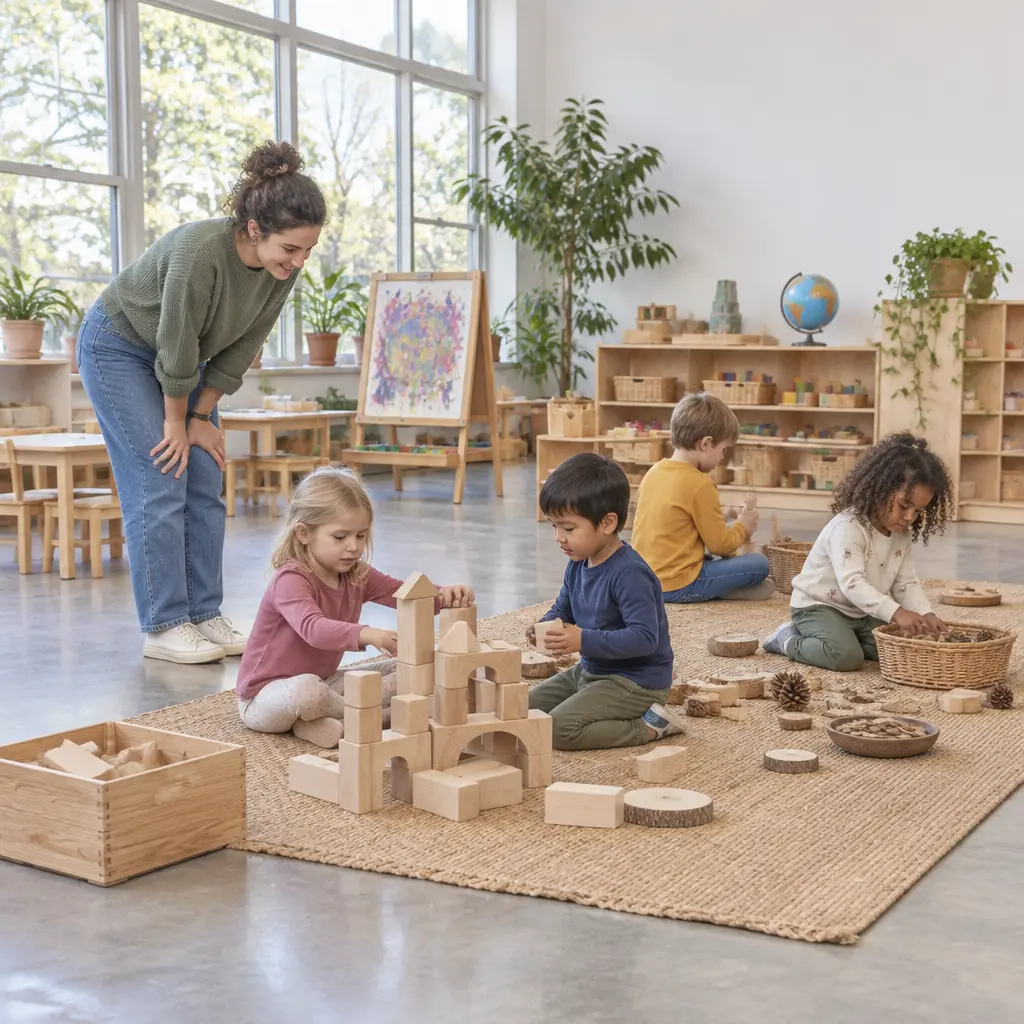
Child-led exploration is a way of learning in which children’s questions, interests, and choices help guide what they investigate, while adults prepare safe, stimulating environments and offer responsive support. It supports school readiness by giving children opportunities to build language, self-regulation, problem-solving, social skills, and early academic knowledge through meaningful play and inquiry. This matters at scale: the National Center for Education Statistics reported that 52% of U.S. children ages 3–5 were enrolled in preprimary education in 2022. Research on early learning, including a major review by the National Academies, emphasizes that children’s development is shaped by active engagement and supportive relationships. The sections below explain what child-led exploration involves, how it nurtures core readiness skills, what evidence and classroom examples show, and how families and educators can put it into practice.
Child-Led Exploration and Its Role in School Readiness
School readiness is not simply knowing letters and numbers before kindergarten. The U.S. Department of Education describes it as a shared responsibility involving children, families, schools, and communities, with attention to children’s development and the settings that support it. Readiness includes approaches to learning, language and literacy, cognition, physical development, and social-emotional development.
Child-led exploration is an approach within this broader picture. In its Developmentally Appropriate Practice framework, the National Association for the Education of Young Children (NAEYC) describes effective early education as play-based and strengths-based, with educators making intentional decisions based on children’s development, individuality, and context. Child-led does not mean adult-free: adults observe, provide materials, maintain safety, and extend learning without taking over the investigation.
The approach includes several related forms: free play, guided play, inquiry-based projects, and outdoor exploration. These differ in how much direction the adult provides, but all can preserve children’s active participation. Their common value is that children have a reason to use new skills: they may count to share materials, explain a theory, negotiate a role, or persist with a construction that keeps falling over.
Free play and child choice
Free play is child-initiated activity in which children choose materials, roles, and goals within appropriate boundaries. A block area, pretend-play corner, or collection of natural objects can become a setting for experimentation, storytelling, sorting, and cooperation. Adults can support access and safety while watching for opportunities to enrich the play with a question or a useful resource.
Guided play and adult scaffolding
Guided play combines a child’s active choice with an adult’s learning goal and timely support. The adult may arrange a puzzle that encourages spatial reasoning, ask children to compare ramps, or introduce vocabulary during a child-chosen investigation. A 2022 systematic review and meta-analysis in Child Development found that guided play can support some learning outcomes, including early mathematics and shape knowledge, compared with direct instruction or free play in particular studies. Results vary by outcome and study design, so guided play is best understood as one useful approach rather than a guarantee of improvement.
Child-Led Exploration Builds Foundational Readiness Skills
Exploration supports readiness when children encounter rich experiences and adults help them notice, describe, and reflect on what is happening. The National Academies’ report Transforming the Workforce for Children Birth Through Age 8 summarizes evidence that early learning develops through interactions among children, caregivers, and the environments around them. The quality of those interactions matters: a child’s curiosity can become a learning opportunity when an adult listens, responds, and adds just enough support.
Language, communication, and early literacy
Language grows when children explain intentions, ask questions, tell stories, and listen to other people’s ideas. During pretend play, for example, children may assign roles, use new words, and create a shared narrative. Educators can extend this learning by naming objects, repeating and expanding a child’s words, reading a related book, or inviting children to draw and dictate what they discovered. These exchanges connect spoken language with vocabulary, comprehension, and early writing.
Executive function and self-regulation
Executive function refers to mental processes used to hold information in mind, manage attention, and adjust actions toward a goal. Harvard University’s Center on the Developing Child identifies working memory, cognitive flexibility, and inhibitory control as core executive-function skills. A child planning a tower, waiting for a turn, or changing a design after it collapses practices these capacities in context. Exploration does not automatically teach self-regulation; predictable routines, supportive adult relationships, and coaching through frustration are important parts of the learning environment.
Early mathematics, science, and problem-solving
Hands-on investigations give children opportunities to compare quantities, notice patterns, classify objects, predict outcomes, and test ideas. A water table can prompt questions about floating and sinking; a collection of shells can invite sorting by size or shape. Adults can make the underlying concepts visible by asking open questions such as “What do you notice?” or “How could we find out?” The National Academies’ review of early development stresses that children are active learners, and that experiences can build conceptual understanding before formal instruction begins.
Social-emotional development and collaboration
When children build, pretend, or investigate together, they practice communicating needs, sharing materials, resolving disagreements, and considering another person’s perspective. These skills contribute to classroom participation and relationships with peers and adults. The U.S. Department of Education’s school-readiness framework treats social-emotional development as one part of readiness, not an optional extra. Adults can support it by modeling respectful language and helping children work through conflicts while leaving room for children to contribute their own solutions.
Conditions That Make Exploration Effective and Inclusive
The benefits of child-led exploration depend on how it is designed. A classroom needs time for sustained play, accessible materials, clear safety expectations, and adults who notice what children are trying to do. It should also welcome different languages, abilities, interests, and ways of communicating. A child who does not use speech, for example, can express choices through gestures, picture supports, assistive communication, or actions with materials.
A prepared environment and responsive adult role
A prepared environment offers varied, open-ended materials that children can use in multiple ways, such as blocks, art supplies, loose parts, books, and safe natural objects. Educators can observe before intervening, then respond with a question, demonstration, or added material when it would deepen the child’s thinking. NAEYC’s developmentally appropriate practice guidance emphasizes intentional teaching alongside play, rather than treating play and instruction as competing choices.
Equity, access, and cultural responsiveness
Equitable exploration means ensuring that each child can participate meaningfully, not expecting every child to engage in the same way. Educators can include familiar home and community experiences, provide materials that reflect children’s identities, and adapt activities for mobility, sensory, or communication needs. The U.S. Department of Education’s 2024 National Educational Technology Plan notes persistent digital divides, including differences in access and meaningful use of technology. For exploration, the practical lesson is to avoid making costly devices a prerequisite: everyday materials, outdoor spaces, conversation, and shared books can provide rich learning experiences.
Observation and assessment without interrupting learning
Teachers can document learning through brief notes, photographs where permitted, children’s explanations, and samples of their work. These observations help educators identify emerging interests and skills, plan next steps, and communicate with families. Assessment should be appropriate to young children’s development and should not reduce readiness to a single test score. The National Academies emphasizes that development is multidimensional and shaped by context, making multiple sources of information more useful than a narrow snapshot.
Practical Examples for Families and Classrooms
A simple investigation can connect children’s interests with several readiness domains at once. If children notice puddles after rain, an educator might offer containers, paper, and safe outdoor access. Children can compare how much water different containers hold, draw what they see, describe changes over time, and decide how to keep a toy boat afloat. The adult supports safety and adds vocabulary, while the children’s questions guide the direction of the activity.
At home, caregivers can invite children to help sort laundry, prepare a snack, build with recycled boxes, or choose a book related to a current interest. These ordinary routines create chances to count, make choices, explain, and cooperate. The goal is not to turn every moment into a lesson; it is to make time for children to explore and to respond with attention when they want to share what they have found.
A chart or classroom display can make the process visible: record children’s questions, their predictions, what they tried, and what they noticed. Such documentation highlights learning as a process rather than only a finished product, and it gives families a concrete way to continue the conversation at home.
Conclusion: Exploration as a Foundation for School Readiness
Child-led exploration supports school readiness by bringing together language, self-regulation, early academic thinking, and social-emotional learning in purposeful activity. Free play preserves children’s initiative; guided play adds intentional adult support; and inclusive environments help ensure that every child can participate. Research and guidance from the National Academies, NAEYC, Harvard’s Center on the Developing Child, and the U.S. Department of Education all reinforce the importance of active learning within supportive relationships and settings.
Families and educators can begin by protecting time for play, offering open-ended materials, following children’s questions, and observing what their activity reveals. For further reading, consult the sources below and consider how everyday routines and classroom spaces can make curiosity, conversation, and discovery part of each child’s path into school.
Sources: National Center for Education Statistics, Preprimary Education, Condition of Education, 2024, https://nces.ed.gov/programs/coe/indicator/cfa; U.S. Department of Education, School Readiness, https://www.ed.gov/teaching-and-administration/early-learning/school-readiness; National Association for the Education of Young Children, Developmentally Appropriate Practice, https://www.naeyc.org/resources/position-statements/dap; Skene et al., Can Guidance During Play Enhance Children’s Learning and Development in Educational Contexts? A Systematic Review and Meta-Analysis, Child Development, 2022, https://srcd.onlinelibrary.wiley.com/doi/10.1111/cdev.13730; National Academies of Sciences, Engineering, and Medicine, Transforming the Workforce for Children Birth Through Age 8: A Unifying Foundation, 2015, https://nap.nationalacademies.org/catalog/19401/transforming-the-workforce-for-children-birth-through-age-8-a; Harvard University Center on the Developing Child, Executive Function and Self-Regulation, https://developingchild.harvard.edu/science/key-concepts/executive-function/; U.S. Department of Education, 2024 National Educational Technology Plan, https://tech.ed.gov/netp/