
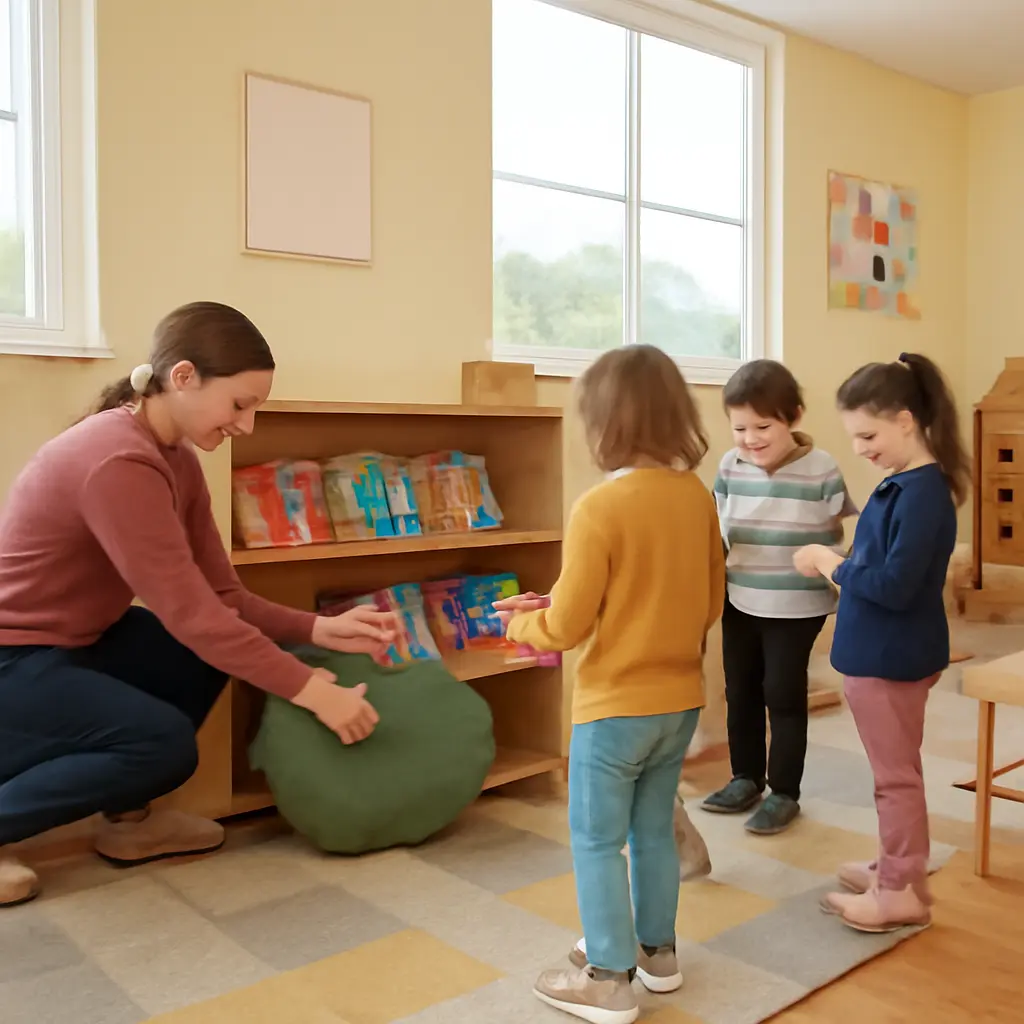
A preschool quiet corner is a small, comfortable space where children can pause, settle, and choose a calm activity—not a place for punishment or forced isolation. The “quiet corner trick” is to make it inviting and predictable, then stock it with a few appealing books, sensory materials, and simple choices. Early-childhood guidance from the National Association for the Education of Young Children (NAEYC) and Head Start emphasizes supportive relationships, responsive environments, and helping children develop self-regulation. Used this way, a quiet corner can support engagement without promising that every child will calm down on a fixed schedule. Here’s how to set one up, guide its use, and assess whether it is helping.
Quiet corner design supports preschool engagement
A quiet corner—also called a calm-down space, cozy area, or regulation nook—is a designated classroom spot where a child can voluntarily take a break from stimulation and engage with soothing materials. It is distinct from a time-out: the goal is to support regulation and a return to participation, not to impose a consequence or remove a child from learning as punishment.
NAEYC’s guidance on developmentally appropriate practice emphasizes designing learning environments around children’s developmental needs and interests. Head Start’s materials on social and emotional development likewise frame self-regulation as a skill children learn with adult support. These principles suggest that a corner works best when teachers introduce it positively, remain available, and help children identify what they need.
A predictable, voluntary space
A useful quiet corner is easy to find, visually calm, and still within the teacher’s supervision. A small rug, cushion, soft light, or low bookshelf can signal that the space is different from busier play areas. It should not be locked, hidden, or used to shame a child. Teachers can explain its purpose during a calm moment and model how to choose it.
The National Center for Pyramid Model Innovations (NCPMI) promotes supportive classroom environments and teaching social-emotional skills proactively. In practice, that means establishing a simple routine: notice a feeling or need, choose the corner or another calming strategy, use a material, and rejoin when ready with adult support if needed.
A small selection of engaging materials
The corner should offer a few purposeful choices rather than a crowded collection. Picture books, emotion cards, a soft toy, drawing paper, or a simple tactile object may help a child focus. Materials should be age-appropriate, safe, washable where practical, and accessible to children with different communication and sensory needs.
Choice matters because children differ: one may want quiet looking, another may benefit from drawing or squeezing a soft object. The U.S. Centers for Disease Control and Prevention (CDC) describes early childhood as a period of rapid developmental change, with children acquiring skills at different rates. Teachers can observe which options a child actually uses rather than assuming one calming tool works for everyone.
Teacher routines make the quiet corner supportive
The physical corner is only one part of the strategy. Teacher language, timing, and follow-up determine whether it feels like a resource or a penalty. Calm, brief prompts—such as “Would you like a quiet moment or help finding a book?”—offer agency while preserving connection. If a child is distressed, an adult can stay nearby, acknowledge the feeling, and avoid demanding immediate explanations.
Teach the routine before children need it
Introduce the corner during a relaxed part of the day. Demonstrate how to enter, choose one item, and leave materials ready for the next child. Use pictures or a short visual sequence for children who benefit from visual communication. Practicing in advance makes the space familiar and reduces the chance that it is associated only with difficult moments.
The U.S. Department of Health and Human Services’ Head Start resources encourage adults to support children’s emotional understanding and coping through responsive interactions. Teachers can connect the routine to language children are learning—“You look frustrated,” “Let’s find a way to feel safe,” or “Tell me when you’re ready”—while accepting gestures, pictures, or silence as communication.
Keep participation connected to learning
A calm break is not a test that a child must pass before returning. When the child is ready, the teacher can offer a gentle bridge back: “The blocks are still here,” or “Would you like to join me at the book table?” This preserves access to classroom activities and avoids turning the corner into an extended exclusion.
The U.S. Department of Education’s guidance on discipline in early learning settings stresses the importance of supportive, developmentally appropriate approaches. If a child repeatedly needs to leave activities, the teacher should look beyond the corner: Is the room too noisy? Is the transition unclear? Is the activity accessible and engaging? A recurring pattern may call for collaboration with the family or a relevant specialist, rather than simply adding more time in the nook.
Quiet corner benefits depend on observation and inclusion
A quiet corner can provide a clear option for taking a break, practicing emotional vocabulary, and returning to play. But it is not a guaranteed behavior fix, and research does not establish one universal design that keeps every preschooler absorbed. Its value depends on how well it fits the children, the classroom, and the moment.
Observe use rather than assuming success
Teachers can make brief notes about when children choose the corner, what materials they use, how long they stay, and whether they rejoin an activity comfortably. These observations are not a score of a child’s behavior; they help adults improve the environment. If a child avoids the space, it may feel uncomfortable, over-stimulating, or too closely linked with correction.
A simple classroom review can compare patterns across the day: Are visits clustered around noisy transitions, waiting periods, or particular activities? That information can prompt practical changes, such as adding a visual transition cue, reducing crowding, or offering a quiet option before frustration builds. Any chart used for this purpose should track environmental patterns, not publicly label individual children.
Make the space accessible and culturally responsive
Children may communicate distress through words, movement, facial expression, or behavior. A supportive corner should accommodate different abilities and sensory preferences, including a clear route for mobility devices and alternatives to materials that could be uncomfortable or unsafe for a particular child. Families can help teachers understand a child’s preferred comfort strategies, languages, and routines.
NAEYC’s equity-focused guidance encourages educators to build environments that respect children’s identities and varied experiences. That principle applies to calm spaces too: avoid assuming that every child wants to be alone, likes the same sensory input, or understands a particular emotion label. Offer options and let children show what helps.
Conclusion: make the quiet corner an invitation, not a consequence
A preschool quiet corner is most useful when its design is welcoming, its materials are intentionally chosen, and its routine keeps children connected to caring adults and classroom learning. Introduce it before stressful moments, offer genuine choices, and observe whether it supports a child’s return to play. The broader lesson is that self-regulation develops through supportive relationships and environments—not through isolation or a one-size-fits-all trick. Start with a small, supervised space, invite children and families to help shape it, and adjust based on what you observe.
Sources: National Association for the Education of Young Children, Developmentally Appropriate Practice, https://www.naeyc.org/resources/position-statements/dap; National Association for the Education of Young Children, Equity and Early Childhood Education, https://www.naeyc.org/resources/position-statements/equity; National Center for Pyramid Model Innovations, Pyramid Model Practices, https://challengingbehavior.org/implementation/classroom/module-1/; U.S. Department of Health and Human Services, Head Start, Social and Emotional Development, https://headstart.gov/school-readiness/article/social-emotional-development; U.S. Centers for Disease Control and Prevention, Learn the Signs. Act Early., https://www.cdc.gov/ncbddd/actearly/milestones/index.html; U.S. Department of Education, Policy Statement on Expulsion and Suspension Policies in Early Childhood Settings, https://www.ed.gov/laws-and-policy/early-learning/policy-statement-expulsion-and-suspension-policies-in-early-childhood-settings