
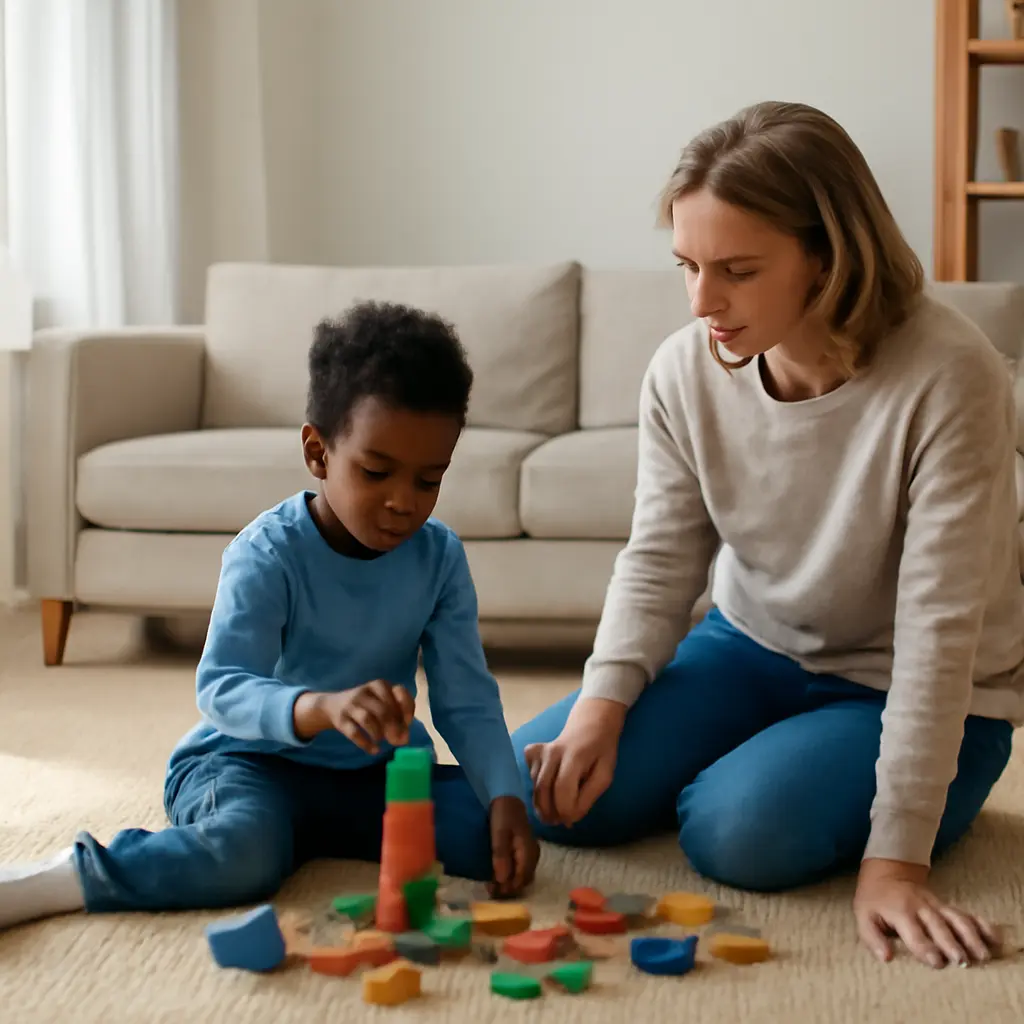
Responsive caregiving is the practice of noticing a child’s cues and responding warmly and appropriately. It helps make everyday interactions—feeding, comforting, talking, and play—opportunities for learning and healthy development. The World Health Organization (WHO), UNICEF, and the World Bank Group identify responsive caregiving as a core component of nurturing care, alongside health, nutrition, safety, and early learning. Evidence from early-childhood research connects sensitive, consistent adult responses with stronger relationships and conditions that support language, thinking, and emotional growth.
Responsive caregiving builds the foundation for learning and development
Responsive caregiving means recognizing and responding to a child’s signals in a timely, warm, and developmentally appropriate way. The WHO, UNICEF, and World Bank Group’s Nurturing Care Framework describes responsive caregiving as one of five interrelated conditions children need to survive and thrive. A baby’s gaze, cry, gesture, or babble—and an older child’s question, frustration, or invitation to play—can all be cues for a caregiver to notice and answer.
The concept includes related practices such as serve-and-return interaction, sensitive caregiving, and responsive feeding. These are not separate techniques so much as everyday forms of attentive care. When adults respond consistently, children have repeated opportunities to communicate, explore, recover from stress, and practice new skills. Responsive care cannot remove every developmental challenge, but it can strengthen the relationships and experiences that support growth.
Serve-and-return interaction supports communication
Serve-and-return describes a back-and-forth exchange: a child makes a sound, gesture, or expression, and an adult responds with attention, words, or an action. Harvard University’s Center on the Developing Child uses this term to explain how ordinary interactions can support early brain development. For example, when a toddler points at a bird and a caregiver follows the point, names the bird, and waits for the child’s response, the child gets practice with shared attention, vocabulary, and turn-taking.
The quality of the exchange matters more than making every moment into a lesson. Pausing, following the child’s focus, and responding in a way the child can understand keeps interaction mutual rather than demanding. If a baby turns away or an older child needs a break, noticing that cue and adjusting is also responsive caregiving.
Sensitive responses help children feel secure
Sensitive caregiving is the ability to notice a child’s needs, interpret cues reasonably, and respond promptly and appropriately. The WHO’s Improving Early Childhood Development guideline recommends responsive care and early learning activities with parents and other caregivers during the first three years of life. A calm response to distress, for instance, can help a young child return to a settled state; over time, children can build skills for managing feelings with adult support.
Responsiveness does not mean granting every request or preventing all frustration. It means setting safe, predictable limits while staying emotionally available. A caregiver can acknowledge a child’s disappointment, explain a boundary simply, and help the child move toward another activity. This combination of warmth and structure supports both connection and growing independence.
Responsive feeding turns care into a learning opportunity
Responsive feeding is an approach in which caregivers recognize hunger and fullness cues and support children to eat in a calm, age-appropriate way. UNICEF’s guidance on nurturing care treats feeding as more than providing food: it can also involve eye contact, conversation, encouragement, and allowing a child to participate as their abilities develop. Caregivers should follow applicable health guidance and seek professional advice when feeding or growth raises concerns.
Across caregiving settings, the common thread is attention to the individual child. That attention becomes especially important during infancy and toddlerhood, when communication is rapidly changing and children rely heavily on adults to interpret their needs.
Responsive caregiving shapes early development through everyday relationships
Responsive caregiving matters because early development is formed through both biology and experience. The WHO-led Nurturing Care Framework highlights that health, nutrition, safety, early learning, and responsive care work together; no single interaction can guarantee a particular outcome. But everyday exchanges give children repeated practice in using language, exploring their surroundings, and managing emotions with support.
The scale of early childhood makes this a significant public-health and education concern. UNICEF estimates that around 250 million children under five in low- and middle-income countries are at risk of not reaching their developmental potential, reflecting overlapping challenges such as poverty, poor health, and inadequate learning opportunities. This global estimate is not a measure of caregiving alone; it underscores why supportive relationships and broader services must be considered together.
Responsive interaction can enrich language and thinking
When adults talk with children, respond to their sounds and questions, and share attention during play, children encounter words and ideas in meaningful contexts. A caregiver describing what a child is doing—“You stacked the big block on top”—connects language with an immediate experience. Harvard’s Center on the Developing Child describes serve-and-return interaction as important to building developing brain architecture, while emphasizing that development is influenced by many experiences and conditions.
Responsive conversation is not limited to books, toys, or formal lessons. Singing during a routine, naming objects on a walk, and answering a child’s question all offer chances to practice listening, expression, memory, and problem-solving. The most useful response is often simple and matched to the child’s attention and developmental level.
Attuned care supports emotional regulation and resilience
Young children are still learning to handle strong feelings. A caregiver who recognizes distress, offers comfort, and helps name an emotion provides external support while the child gradually develops self-regulation. The Harvard Center on the Developing Child explains that supportive relationships can help buffer children from the effects of stress. This does not mean children should never experience difficulty; it means that dependable adult support can help them cope.
For example, when a preschooler becomes upset after a toy breaks, an adult can first acknowledge the feeling, then help the child calm down and consider what to do next. Repeated experiences of being heard and guided can help children practice recovering from setbacks and asking for assistance.
Play lets children practice skills with a supportive adult
Play-based interaction gives children room to explore, imagine, and solve problems while caregivers follow their interests and offer help when needed. The adult might take a turn, add a new word, or ask an open-ended question without taking over. This balance allows the child to lead while still benefiting from encouragement and guidance.
The WHO guideline on early childhood development recommends opportunities for early learning alongside responsive care. A household does not need specialized equipment to support play: safe household objects, songs, conversation, and shared routines can all provide meaningful experiences. What matters is that activities are safe, engaging, and suited to the child’s abilities.
Responsive caregiving can be practiced in homes and early-childhood settings
Responsive caregiving is relevant wherever children spend time with adults: at home, in childcare, in preschool, and in community health programs. Its practical forms vary with a child’s age, culture, abilities, and circumstances, but the core process stays consistent: notice a cue, respond thoughtfully, and adjust based on the child’s reaction.
Caregivers can build responsiveness into daily routines
Daily routines offer repeated, low-cost opportunities for connection. During dressing, meals, bathing, or travel, adults can talk with children, allow time for their responses, and offer manageable choices. If a child signals tiredness or overload, adjusting the pace can be more helpful than insisting on continued engagement.
- Pause and observe before stepping in; look for gaze, gestures, sounds, movement, and changes in mood.
- Follow the child’s attention and respond with words, facial expressions, touch, or assistance appropriate to the child.
- Allow time for a reply, even when the reply is a look, movement, or sound rather than spoken language.
- Use predictable, warm limits to keep children safe while recognizing their feelings.
- Ask a pediatrician or early-childhood professional for guidance when developmental, communication, or feeding concerns persist.
Early-childhood programs can support responsive relationships
In group settings, responsive care includes learning each child’s cues, providing dependable routines, and making time for one-to-one exchanges even when staff are caring for several children. Programs can encourage family communication and use observation to adapt activities to children’s interests and needs. The WHO’s guidance also emphasizes support for parents and caregivers, recognizing that nurturing relationships depend partly on the resources and wellbeing available to adults.
A useful way to picture the process is a simple cycle: child cue → adult notice → warm response → child reaction → adult adjustment. This text-based diagram illustrates that responsiveness is an ongoing exchange, not a single technique or a test of parental perfection.
Conclusion: responsive caregiving makes everyday moments count
Responsive caregiving brings together serve-and-return interaction, sensitive responses, responsive feeding, and supportive play. Evidence-based guidance from the WHO, UNICEF, the World Bank Group, and Harvard’s Center on the Developing Child shows why attentive relationships are a core part of children’s nurturing environments. They create repeated opportunities for communication, emotional support, exploration, and learning, while working alongside health, nutrition, safety, and quality early education.
Caregivers do not need to make every interaction perfect. They can start by noticing a child’s cues, responding warmly, and adjusting when the child communicates a different need. Families and early-childhood professionals can also seek local parenting resources, developmental screening, and support services—because helping adults provide responsive care is part of helping children thrive.
Sources: World Health Organization, UNICEF, World Bank Group, Nurturing Care Framework, https://nurturing-care.org/nurturing-care-framework/; World Health Organization, Improving Early Childhood Development: WHO Guideline, https://www.who.int/publications/i/item/97892400020986; UNICEF, Early Childhood Development, https://www.unicef.org/early-childhood-development; Harvard University Center on the Developing Child, Serve and Return, https://developingchild.harvard.edu/science/key-concepts/serve-and-return/; Harvard University Center on the Developing Child, Toxic Stress, https://developingchild.harvard.edu/science/key-concepts/toxic-stress/; Black, M. M., et al., “Early childhood development coming of age: science through the life course,” The Lancet, 2017, https://doi.org/10.1016/S0140-6736(16)31389-7.